John Lloyd Stephens Visits Uayalceh, 1839
| In 1839, and again in 1841, a New York
lawyer and adventurer named John Lloyd Stephens traveled through Central America and
Yucatán searching for lost Mayan cities. A friend of his, Frederick Catherwood, went with
him and drew sketches of the ruined buildings that they found. The books Stephens wrote
about his trips were very popular - they still make good reading - and brought the Maya
civilization and its works back to the attention of the world. While he was in New York, getting ready for his first trip, Stephens met an "unpretending" Yucatecan named Don Simón Peón who was in New York for business. Don Simón invited Stephens to look him up if Stephens came to Mérida. When Stephens arrived in Mérida but Don Simón was out of town at his hacienda at Uxmal. Don Simón's mother, Donna Joaquinna, however, was very gracious and made arrangements for Stephens and Catherwood to travel to Uxmal, staying at the Peón haciendas on the way. One of these hacienda's was Uayalceh. Here is Stephen's description of the day's travel to Uayalceh and beyond, to the hacienda of Mucuyche, where he spent that night.
|
|
| Stephens and Catherwood leave Mérida heading south to Uxmal. They come to a hacienda. | The next morning at half past six we set out for Uxmal on horseback, escorted by a servant of Senor Peón, with Indians before us, one of whom carried a load no provided by us, in which a box of claret was conspicuous. Leaving the city, we entered upon a level stony road, which seemed one bed of limestone, cut through a forest of scrub trees. At the distance of a league we saw through a vista in the trees a large hacienda belonging to the Peón family, the entrance to which was by a large gate into a cattle yard. The house was built of stone, and had a front of about one hundred and fifty feet, with an arcade running the whole length. It was raised about twenty feet, and at the foot was a large water-trough extending the whole length, about ten feet wide and of the same depth, filled with water for cattle. On the left was a flight of stone steps, leading to a stone platform on which the hacienda stood. At the end of this structure was an artificial reservoir or tank, also built of stone and cemented,m about one hundred and fifty feet square, and perhaps twenty deep. At the foot of the wall of the tank was a plantation of henniken, a species of aloe, from the fibres of which hemp is made. The style of the house, the strong and substantial character of the reservoir, and its apparent costliness, gave an imposing character to the hacienda. |
| They continue to a second hacienda where they breakfast. | At this place our Indian carriers left us, and we took others from the hacienda, with whom we continued three leagues farther to another hacienda of the family,of much the same character, where we stopped to breakfast. This over, we set out again, and by this time it had become desperately hot. |
| They continue their journey through the morning heat
and arrive at Uayalceh. A description of the building.
|
The road was very rough, over a bed of stone thinly covered, with barely
soil enough for the growth of scrub-trees; our saddles were of a new fashion, and most
painfully trying to those unused to them; the heat was very oppressive, and the leagues
very long, till we reached another hacienda, a vast, irregular pile of buildings of dark
gray stone, that might have been the castle of a German baron in feudal times. Each of
these haciendas had an Indian name; this was called the hacienda of Vayalquex, and it was
the only one of which Donna Joaquina, in speaking of our route, had made any particular
mention. The entrance was by a large stone gateway, with a pyramidal top, into a long
lane, on the right of which was a shed, built by Don Simón since his return from the
United States as a ropewalk for manufacturing hemp raised on the hacienda; and there was
one arrangement which added very much to the effect, and which I did not observe anywhere
else: the cattleyard and water-tanks were on one side and out of sight. We dismounted
under the shade of noble trees in front of the house, and ascended by a flight of broad
stone steps to a corridor thirty feet wide, with large mattings, which could be rolled up,
or dropped as an awning for protection against the sun and rain. On one side the
corridor was continued around the building, and on the other it conducted to the door of a
church with a large cross over it, and within ornamented with figures like the churches in
towns, for the tenants of the hacienda. The whole establishment was lordly in its
appearance. It had fifteen hundred Indian tenants, bound to the master by a sort of feudal
tenure, and, as the friends of the master, escorted by a household servant, the whole was
ours.
|
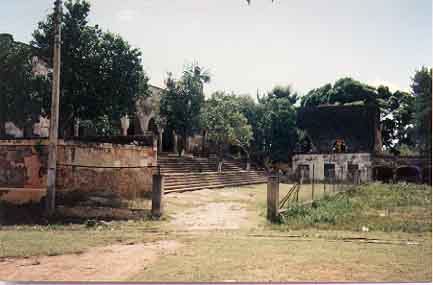
This may be the direction from which Stephens came up on the main house. Here are the noble trees and the flight of broad stone steps. This picture was taken 155 years after Stephen's arrival.
|
|
| A digression on the importance of water in the Yucatan and its effect on the social system | We had fallen unexpectedly upon a state of things new and peculiar. The peninsula of Yucatan, lying between the bays of Campeachy and Honduras, is a vast plain. Cape Catoche, the northeastern point of the peninsula, is but fifty-one leagues from San Antonio, the western extremity of the Island of Cuba, which is supposed at a remote period to have formed part of the American Continent. The soil and atmosphere are extremely dry; along the whole coast, from Campeachy to Cape Catoche, there is not a single stream or spring of fresh water. The interior is equally destitute; and water is the most valuable possession in the country. During the season of rains, from April to the end of October, there is a superabundant supply; but the scorching sun of the next six months dries up the earth, and unless water were preserved man and beast would perish, and the country be depopulated. All the enterprise and wealth of the landed proprietors, therefore, are exerted in procuring supplies of water, as without it the lands are worth nothing. For this purpose each hacienda has large tanks and reservoirs, constructed and kept up at great expenses, to supply water for six months to all dependent upon it, and this creates a relation with the Indian population which places the proprietor somewhat in the position of a lord under the old feudal system. |
| Relation between the hacienda and the Indians. The major-domo of Uayalceh | By the act of independence, the Indians of Mexico, as well as the white population, became free. No man can buy and sell another, whatever may be the colour of his skin; but as the Indians are poor, thriftless, and improvident, and never look beyond the immediate hour, they are obliged to attach themselves to some hacienda which can supply their wants; and, in return for the privilege of using the water, they come under certain obligations of service to the master, which place him in a lordly position; and this state of things, growing out of the natural condition of the country, exists, I believe, nowhere else in Spanish America except in Yucatan. Each hacienda has its major-domo, who attends to all the details of the management of the estate, and in the absence of the master is his viceroy, and has the same powers over the tenants. At this hacienda the major-domo was a young Mestitzo, and had fallen into his place in an easy and natural way by marrying his predecessor's daughter, who had just enough white blood to elevate the dulness of the Indian face into one of softness and sweetness; and yet it struck me that he thought quite as much of the place he got with her as of herself. |
| Departure from Uayalceh in a coach | It would have been a great satisfaction to pass several days at this lordly hacienda; but, not expecting anything to interest us on the road, we had requested Donna Joaquina to hurry us through, and the servant told us that the senora's orders were to conduct us to an9ter hacienda of the family, about two leagues beyond, to sleep. At the moment we were particularly loth to leave, on account of the fatigue of the previous ride. The servant suggested to the major-domo llamar un coche; in English, to "call a coach," which the latter proposed to do if we wished it. We made a few inquiries, and said, unhesitatingly and peremptorily, in effect, "Go call a coach, and let a coach be called." The major-domo ascended by a flight of stone steps outside to the belfry of the church, wither we followed him; and, turning around with a movement and tone of voice that reminded us of a Musselman in a minaret calling the faithful to prayers, he called for a coach. The roof of the church, and of the whole pile of buildings connected, was of stone cemented, firm and strong as a pavement. The sun beat intensely upon it, and for several minutes all was still. At length we saw a single Indian trotting through the woods toward the hacienda, then two together, and in a quarter of an hour there were twenty or thirty. These were the horses; the coaches were yet growing on the trees. Six Indians were selected for each coach, who, with a few minutes' use of the machete, cut a bundle of poles, which they brought up to the corridor to manufacture into coaches. This was done, first, by laying on the ground two poles about as thick as a man's wrist, ten feet long and three feet apart. These were fastened by cross-sticks tied with strings of unspun hemp, about two fee from each end; grass hammocks were secured between the poles, bows bent over them and covered with light matting, and the coaches were made. We placed our ponchas at the head for pillows, crawled inside, and lay down. The Indians took off little cotton shirts covering the breast, and tied them around their petates as hatbands. Four of them raised up each coach, and placed the end of the poles on little cushions on their shoulders. We bade farewell to the major-domo and his wife, and, feet first, descended the steps and set off on a trot, while an Indian followed leading the horses. In the great relief we experienced we forgot our former scruples against making beasts of burden of men. They were not troubled with any sense of indignity or abasement, and the weight was not much. There were no mountains; only some little inequalities which brought the head lower than the heels, and they seldom stumbled. In this way they carried us about three miles, and then laid us down gently on the ground. Like the Indians in Mérida, they were a fine-looking race, with a good expression of countenance, cheerful, and even merry in their toil. They were amused at us because we could not talk with them. There is no diversity of Indian languages in Yucatan; the Maya is universal, and all the Spaniards speak it. |
|
|
| When they left Uayalceh they traveled
about eight kilometers further to the hacienda of Mucuyche where they found an underground
cenote and had a refreshing swim. They next day they arrived at the hacienda of Uxmal and
began to study the ruins there. The five haciendas described here, two before reaching Uayalceh, Uayalceh itself, Mucuyche, and Uxmal, were all owned by the "unpretending" Don Simón Peón. Peón was born in 1808 and as a businessman was deeply involved in the development of the henequen industry in Yucatán. He and his family supported Maximilian. He died in Veracruz on his way into political exile in 1869. You can read more abut Don Simón Peón, his family, and the development of the henequen haciendas in Yucatán, by going to the web page "Peón Papers Reflect Development of Haciendas in Yucatán" by Maritza Arrigunaga. Stephens talks about henequen several times. In 1839 the henequen industry was young. Some commercial development had begun in the late eighteenth century, and interest began to intensify in the late 1820s and the early 1830s. The first large-scale henequen plantation was started in 1833. Within 50 years the henequen industry would boom and create incredible wealth for the owners of planations like Uayalceh. Kathryn Stafford wrote a readable history of the henequen industry for Americas, "Yucatan's Ancient Roots." in 1994. Americas is a publication of the Organization of American States. Look for volume 46, number 4, pages 22-29. Stafford, by the way, noting that many hacienda homes (including the one at Uayalceh) were built on platforms, says that at least one archeologist has suggested that some of these platforms may be the remains of Mayan temples.
|
|

This page was last updated on Sunday, April 11, 2004.