Life at the Quinta
|
|||||||||||
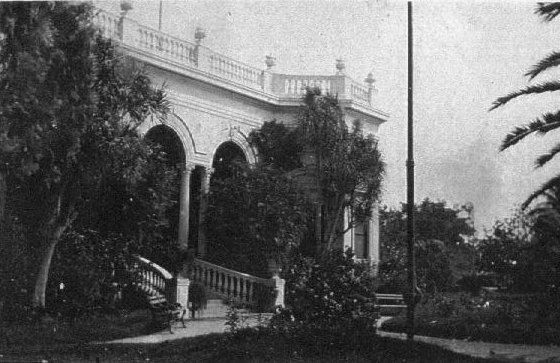
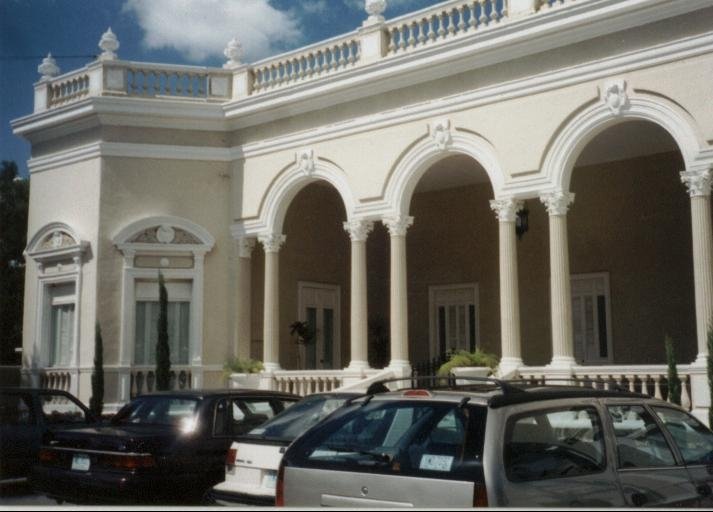
| The Quinta was the villa that
Beatriz's father, Pedro de Regil, built for her mother on the northern outskirts of Merida
(on the road to Itzimna). It was nearing completion in 1903 when her father died on
a trip to Mexico city.
|
Two distinct ways of life went on simultaneously at the Quinta, that of the adults and that of the nursery, and later of the schoolroom. At certain hours our paths might cross, but each was separate and distinct and could go on irrespective of the other. My mother had given up her former habit of getting up for five o'clock Mass, but remained an early riser and seven o'clock would find her sitting at the dining room table, where she breakfasted off fruit, toast and the excellent orange marmalade which she herself made from bitter oranges. Near her place at table there was always a gold and red tin of Danish butter and a little saucer of "natas", an accumulation of the "skin" which formed on the milk as it was boiled. It tasted somewhat like Devonshire cream. By nine mother would be bathed, dressed and ready to start to town. In my earliest memories she set out in the Victoria, which was driven by the English coachman, Spencer, magnificent in full regalia of green uniform coat, white trousers and cockaded top hat. He was a gaunt sandy-haired man, an excellent coachman and devoted to his charges, the two fat carriage horses, the dashing mares, Nora and Flora, and the two ponies -- fat Bobby, mouse colored, blue-eyed and mean tempered -- and the meek Neddy. In his spare time he collected stray dogs, and antiques of the early Victorian era. Every year on my birthday, he would present me with one of his treasures, and to this day I have a silver- plated cup and saucer with my name engraved on it and a small mahogany chest with bone inlay. His most enchanting gift, a white and gold china night-light, shaped like a Gothic castle, must have been left behind when we sold the quinta.
Spencer was greatly moved when he saw animals mistreated and he had been known to jump off his high perch on the carriage to belabour a man who was beating a wretched mule with sores on its hide. He had been known to go out and shoot sick animals which cruel owners had turned out to die in the street. One of his foundlings was a hideous bitch named Minny who, at stated intervals, gratefully presented us with numerous and fascinating puppies. The drive to Merida was always leisurely as Spencer would not hurry the horses. My mother made a charming picture as she sat in the gently swaying green-upholstered seat, dressed in sparking white linen skirt and blouse and plumed black had, and holding a silk parasol to keep off the fast-warming sun. |
||||||||||
The order of the morning's errands was always the same; the office, a visit to Tia Felipa's; perhaps some shopping, then another visit. At the office there was endless discussion of the affairs of the plantations, of politics, and some discreet gossip. Once a week there was a mail from Europe by way of New York -- on another day from Mexico City and points within the Republic. The mail came by sea on one of the ships of the Ward line which called each week at Progresso. Arrival of letters caused a delightful ripple of excitement on the smooth surface of one's life -- we savoured every line of every letter and magazine -- I might add, of every advertisement. Business and visits over, my mother would come home, the horses clip-clopping lazily under the now torrid sun. At home nursery life would have flowed on serenely, with lessons and play at fixed intervals. In the distance the quiet house voices played a muted accompaniment; the slap-swish of the damp rag passing on the tiled floors, the flapping of Maria Jalapena's slippers as she changed the flowers in the vases of the long gallery, the rhythmic pat-pat of the kitchen maid making tortillas in the kitchen wing. On breezy days the windmill would start to creak and groan and whirr every few minutes -- and from the garden would come the busy cackle of guinea fowl and the barking of dogs. By eleven the sounds would die down, but a new sense of expectancy would settle over the house -- the Senora would soon by home and the midday meal served. I would lose interest in "Reading without Tears" or in "Little Arthur's History of England" and Miss Cogan, my governess, would close the books and give the welcome signal for the washing of hands and changing into a clean, starched white pinafore which preceded my mother's arrival. Then come the sound of horses' hoofs, the crunching of gravel under wheels, the creaking of the gates -- and in no time mother was in the house, her arms full of packages and papers -- and of me! It was the moment of questions, and I would want to know all she had done and seen. I never remember her talking down to me -- my questions were always answered and she would add little details which had made the morning amusing and memorable. All this took place in her bedroom, where I would watch her slip out of her limen skirt and lingerie blouse and into a cool negligee of sprigged French lawn and then dab her face with toilet water. She always used Hudnut's "Violet-sec", a faint haunting scent evoking memories of violet carpeted woods. Lunch was always a most enjoyable meal. Mother loved good food. She was not greedy, but she appreciated fine cooking and had no use for unsavory food no matter how elegantly served. She was a superb occasional cook. I use the adjective deliberately for I cannot picture her chained to the drudgery of turning out the daily meals, each with the correct number of calories and vitamins -- but when the spirit moved she could spend hours whipping up most delicious cakes and puddings, or improvising dishes from the meats and vegetables on hand. Her "chicken marengo," whilst it lacked half the traditional ingredients, was a triumph, and her chicken consomme was clearer and more delicate than any I have ever tasted. Her pie crust was delicious and has made one very critical of the zestless pies one so often encounters. She made mayonnaise from scratch, a delicate pale, pale yellow sauce with a tangy, haunting flavour of the small green Yucatecan limes she used in preference to large lemons. It took an hour to make, but was worth the sore arm which went along with it. She was the deadly foe of the "marshmallow and jelly" school of cookery -- and of the lumpy white sauce which masked so many dishes of tough chicken or flabby fish. She accomplished miracles in teaching and supervising the Maya cooks, so that we could always count on interesting meals, which were a compromise between the over-lavish spread of local custom and the unimaginative but healthy English luncheon. There was always a soup with plenty of body and flavour, or one of the rice and egg and banana concoctions which are such an attractive feature of Mexican cuisine. This was followed by a roast of meat or fowl, potatoes and a green vegetable -- the English core or heart of the meal -- and a concession to the nursery denizens. I endured this course, but set my hopes on the next, which was always a dish of frijoles, accompanied by a savoury salad, perhaps of tiny cucumbers cut paper thin, or of chayotes and tender green lettuce, cool and fresh as the dawn. At the same time a "lehk" (a hollow gourd) piled with piping hot tortillas wrapped in an embroidered napkin would be set on the table -- also a "taster" dish of whatever was being eaten in the kitchen that noon -- tamales -- dried venison in "salpicon" (a seasoning of the juice of bitter oranges and chopped radished and cilantro) a "papadzul" pan de cazon -- always something in the Maya tradition. The sweet course might be anything, English milk pudding, Mexican flan, stewed fruits -- jam tarts, one of the many coconut and sherry concoctions native to Yucatan, or even suet pudding ("Spotted dick" or roly poly) if my mother were feeling homesick for England. Fresh fruits ended the meal, oranges, cajeras (a bitter-sweet-orange with a rough, warty skin, easy to peel like a tangerine), purple caimitos, sweet limes - mamey - whatever might be ripe at the moment. (Mangoes were not in season). From our present viewpoint the meal might be considered gargantuan, but it was our main meal, and by eating small servings it could be considered more varied than heavy. Supper was a mere trifle (so had been breakfast) -- a cup of soup -- perhaps a cold dish and some fruit. But luncheon was a serious meal, dividing our workday morning from the social afternoon. From the table the grownups went straight to their hammocks and the pleasant half lights of the bedroom. This was a hot time of day when the sun beat down burning and searing, and the sky seemed no longer blue, but a shimmering grey. All Yucatan lay panting and drowsy and not a breath of air moved the leaves nor stirred the dust. For me it was the sweet hour of no accounting. Provided I stayed indoors I could do as I pleased; pore over old magazines and books in the gallery or library; make a museum-like tour of the drawing room; or settle down in my own quarters to my fairy tales or toys. As I grew older, in the manner of only children, I acquired secret companions. The rows of plants on the plantstands became members of the classes at a school, and I would lecture to them, punish or reward them as the situation demanded. At two o'clock there was a stirring in the house. Very slowly life flowed back. My school books were again pulled out, and two hours of study lay ahead with no distractions other than the arrival of Maria at three o'clock with the mid-afternoon lemonade and a bucket of hot water for Miss Cogan's bath. Sound of running water and soft splashes, the dry sound of palm leaves stirring in a little breeze, the far away sound of water sprinklers in the garden -- the whole world was coming alive again. My mother always spent the hour between her siesta and tea- time going over the cupboards, bookcases, linen chests and -- on one supreme afternoon of each winter -- of the safe. It was a necessary chore, for the silverfish, dry rot and other pests of the tropics could reduce the contents of a closet to shreds in a few short months. So there was the yearly ritual of turning everything our, sunning the articles, then replacing them, wrapped up in unwashed, unbleached calico -- with plenty of camphor and of Keatings insect powder sprinkled around. To my mother all this must have seemed tiresome, but for me it was the uncovering of treasure. It was in this way I acquired an old edition of Longfellow with copper engravings, which was curiously housed among my mother's laces and frippery. Also Gray's Elegy in booklet form, with gaudy, heartwarming Victorian illustrations -- and, in great contrast to these literary finds, sample bottles of French perfumes, carved wooden boxes from Austria and magnificent French silk ribbons. My mother let me handle all her precious objects, telling me about them, so that for me these hours of housecleaning were like a very interesting geography lesson, in which I acquired a taste for strange places and beautiful things. The tea hour came all too soon and I would join Miss Cogan in the garden where the lengthening shadows made great splashes of coolness. The two antique mahogany nursery chairs would be set out near a tea-table on which was a dish of bread and butter, the fat blue Chinese ginger jar which served as jam pot; and either a homemade seed or raisin cake, or a box of Huntley and Palmer biscuits. The milk pitcher was squatty, and sprigged with roses, the teacups odd ones of transparent Japanese porcelain. From our shady spot we could watch the world go by beyond our gateposts -- the little mule-pulled yellow tramcars; youths on horseback or riding bicycles and -- great moment -- the convent tram filled with a chattering mob of girls dressed in white. Many were my cousins and friends, so I would wave frantically as they passed. Close to us was a circle of dogs, rabbits and peacocks, all waiting for tidbits. The rabbits were so tame they would eat bread and milk out of a saucer put for them on the grass. This was the visiting hour and my mother was always ready for a sudden descent of relatives. They came by tram or by carriage, groups of chattering birdlike women in pretty, fussy cotton frocks, with much waving of fans -- and sometimes their husbands came too. The gentlemen mopped their foreheads with large linen handkerchiefs. It was all pleasant and exciting, except for the kisses with which the ladies were so lavish. I would stay around for possible handouts, bits of my mother's hot buttery teacake or shortbread, items considered too rich for the nursery tea. But soon, bored by grownup conversation I would drift out to the garden in search of adventure. The sky was blue again, and high -- with enormous white clouds billowing up in fantastic shapes. Gradually the blue gave way to the pink and gold of sunset; a time of day always beautiful in Yucatan and incredibly melancholy. Once I saw a flight of pink flamingos fly across the sky at sunset; a lovely sight. In the Tropics night comes quickly; dark and velvety, and with a merciful release from the heat of the day. But for me night had more terrors than beauty. As in England, ghosts walk in Yucatan, and I was terrified of the big dark rooms of the house, especially of the library where I imagined the frog deities in the shelves were playing with the Olmec cat and the horrible head of a bearded man had suddenly acquired a body and was lurking - ready to pounce. From my hammock I would strain to catch the sounds of ordinary life, the rhythmic creak of my mother's rocking chair in the gallery, the hum of voices when there were guests, the pleasant kitchen noises. In the next room Miss Cogan sat writing. Gradually sleep claimed me. It was pleasant in the hammock with the cool linen sheet wrapped around me. The mosquito net had been searched thoroughly for lurking spiders or scorpions, and my thirst had been quenched by a long drink from the earthenware water jar. It was pleasant, and cool and safe.
|
|||||||||||
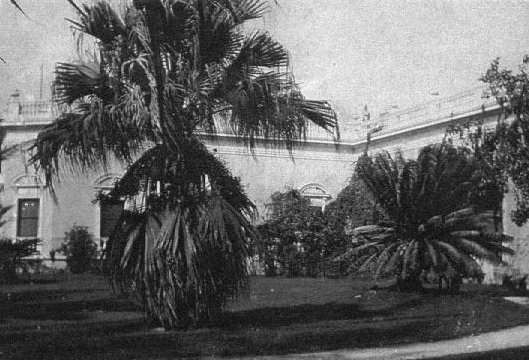
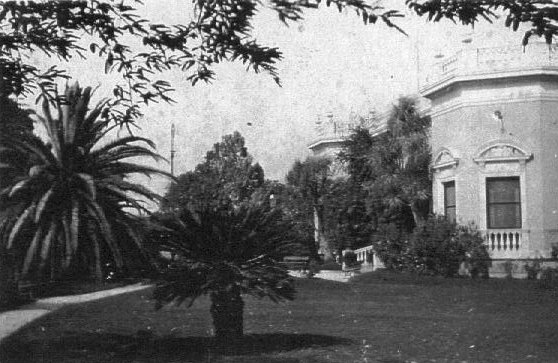
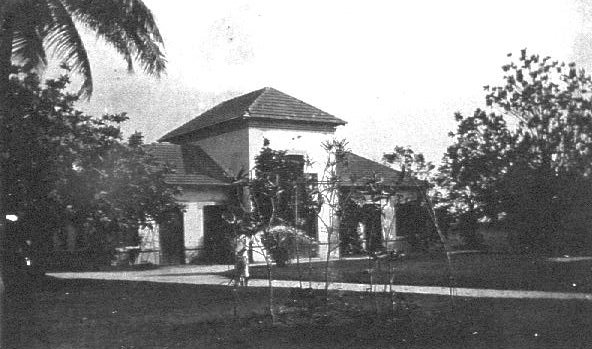
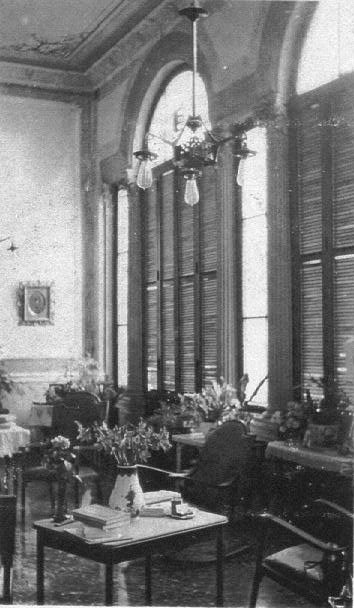
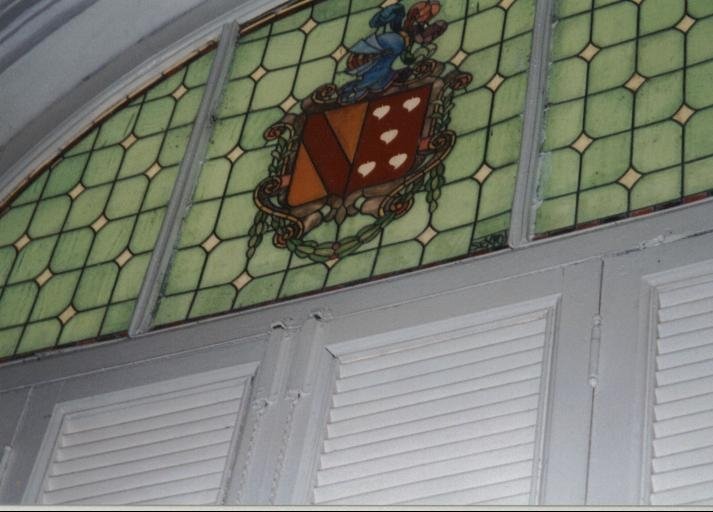
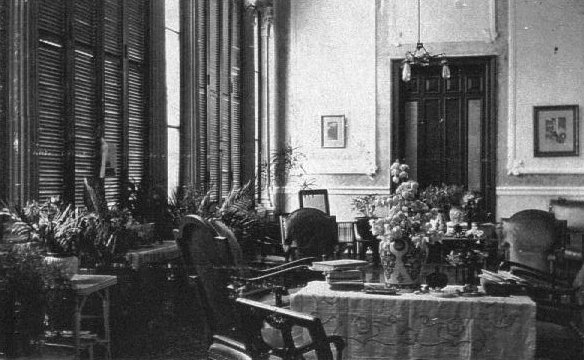
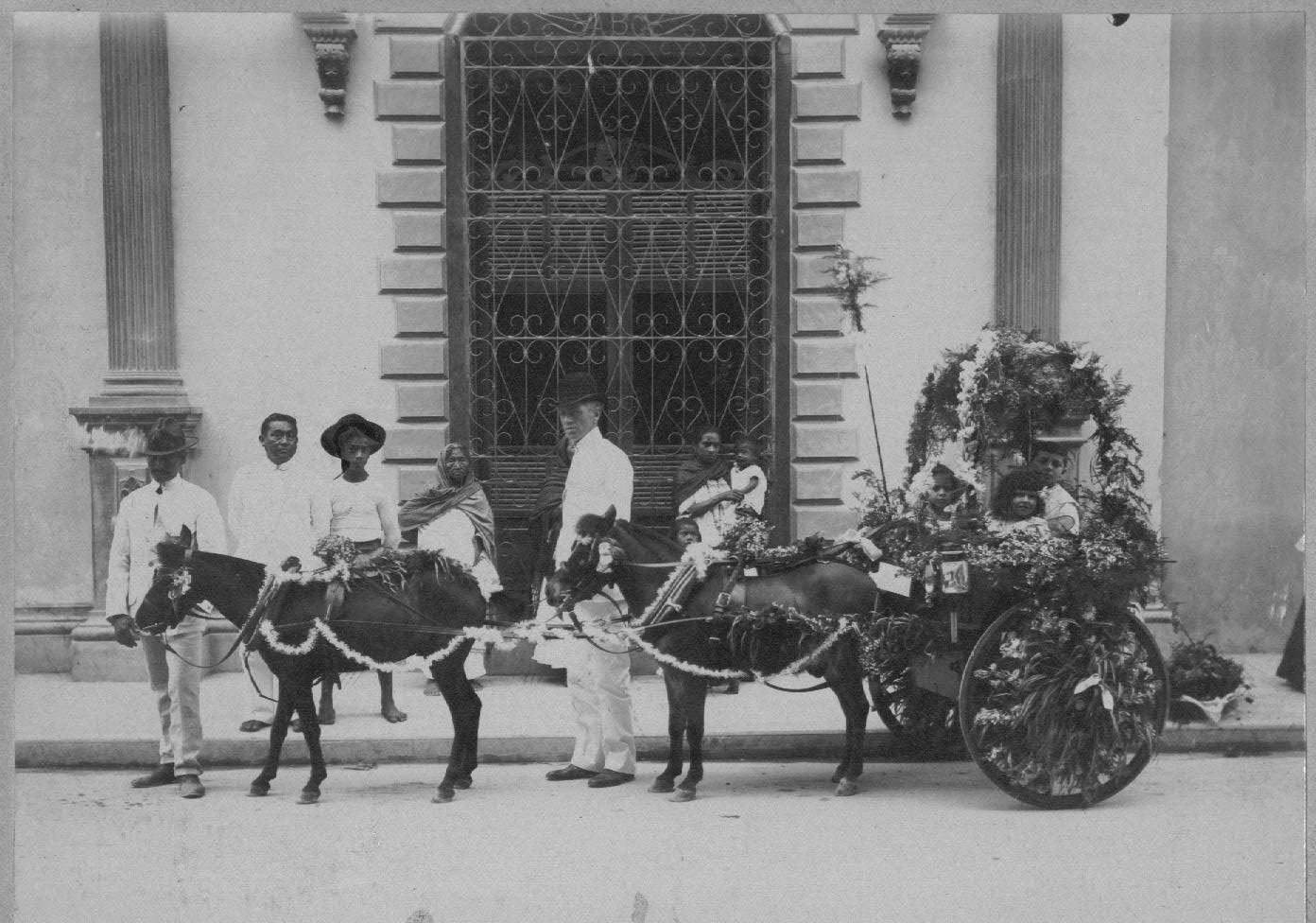
| The Quinta then (about 1920) and now (1994) | |
 |
 |

This page was last updated on Sunday, April 11, 2004.