
My Mother and I
 Beatriz and her mother in 1901 Click here to read a letter to The Times of London, telling about Augustus Baker's adventures in Serbia's war against the Turks in 1876. |
I have put us together advisedly, for until I was ten I cannot think of myself except in conjunction with my mother. This closeness was not intentional on her part; it was simply that anyone with her charm, personality and beauty was bound to overshadow and enfold all who came near her. I never once questioned her judgment, nor wished for one minute to strike out for myself in the physical world -- though in the world of my imagination I kept my own thoughts. My mother was the eldest of the five children of Augustus Baker, an eccentric English public servant. He had been a medical student at one time, and had joined Serbia in her struggle for independence in helping to organize such medical services as were possible for the relief of the wounded. He was a born wanderer and had travelled to far-off places including the Sudan. He drifted into the Consular Service and ended his days as Consul General at Veracruz, Mexico. It was here that he crossed the path of the Regil family. My grandmother, Augustus Baker's pleasant faced, auburn haired young wife Maria Katherine Jefferies died in ____ and the children were brought up in London by his mother, Charlotte Baker. She was a fascinating old lady and one of Cardinal Newman's converts to the Catholic Faith. Though the children were brought up strictly and frugally, yet they all grew up with a feeling of affection for their grandmother and respect for her integrity. The house they lived in was a tall, narrow London house and they managed to have fun in spite of restrictions. Katherine, May, Gertrude, Bernard and Jeffery were all as unlike as brothers and sisters could be. Of the girls, pretty, vivacious Gertie was musical; cosy, matter-of-fact May was an artist, whilst Katherine, black-haired and beautiful grew up with an aptitude for appreciating the best in art and literature. (Curiously, she never grew to like classical music!) She was more mature in manner than the others and her grandmother trusted her with many of the household decisions. It was she who chose the materials and styles for their dresses, carried her grandmother's orders to the servants, and saw that they were executed. I do not think she felt much happiness as a child. I only remember two anecdotes of those days.......of how May loved raisins and how she would dig them out of the rice pudding and place them along the side of her plate only to have the boys steal them from her in an unguarded moment.....and of the terrible day when the children all got out on the ledge outside a third floor window and walked along to the next window into the waiting arms of their grandmother. (The very thought of this escapade would fill Nena Regil and me with horror) ---- But on the whole her childhood was not lighthearted, though it molded her for the part she was to play in later years. A dear relative once reproached her, in my hearing, for being a Martha, a reproach she took very much to heart. "If I were not a Martha, what would happen to the Marys?" she said to me sadly. She had shouldered responsibility all her life - as child and mature woman. When she was about seventeen, life in the London house changed for my Mother. Her father, at home for a visit, decided to introduce her to his friends. He moved in interesting circles - though in later years my mother only kept up with a few of his friends, the Fisher Unwins and the Thomassons. Mrs. Unwin was the daughter of Richard Cobden, the great apostle of Free Trade, whilst Mrs. Thomasson was the daughter of John Bright, another liberal Victorian statesman. Mr. Unwin headed one of the finest publishing houses in England. They were all people of solid fortune and great culture -- greatly influenced by Quaker antecedents. Mother never told me who was responsible for putting her into the hands of a French dressmaker, but at the first dinner party she attended with her father the guests were startled to see a radiantly lovely girl dressed in red silk, emerald green circling her slender waist, and lilies of the valley nestling at her throat, when they had expected a bread and butter miss in maidenly pink and white. The French dressmaker had sensed the fire and gentleness of her client and the dress was prophetic. My grandfather was established as Consul General in Veracruz when he took my mother to live there with him. I never straightened out the tangled threads of the story -(and my mother was most reticent on the subject) but I got the impression that on the voyage out she met a young Mexican returning from his years of study abroad, and that they found each other pleasing. My mother never spoke to me of my father's courtship though she did tell me she was married in the big church on the main plaza of Veracruz. I remember once going into the Church and wondering how it looked on the day she was married, and trying to imagine her in a white satin dress with a great train and with a coronet of orange blossom caught in her upswept black hair. But there was no photograph to substantiate my imaginings, and Mother never spoke of it. My grandfather was a good specimen of the Victorian parent, and Veracruz was a small, dull town. Between the two it is a wonder my mother kept her sanity. Word of the beautiful English girl got around, and all the eligible young men of Veracruz indulged in the time honored pastime of going round and round the block on which she lived. They went on horseback and they went of foot. Intrepid souls even sent bouquets of flowers, only to have them thrown back into the street by Her Majesty's Consul. Every morning a group of patient fellows, mounted on beautiful horses, waited for Mother and her father to ride out of the Consulate "Zaguan", and would follow them at a discreet distance as they went along the ill paved street down to the beach. My mother was a good horsewoman, and many people have told me that she looked like a princess on horseback. She and her father would gallop along the shore of the Gulf, until the hot sun beating down drove them homeward, their escort still in attendance. It must have been lonely for her. Veracruz was a dull, dirty and unhealthy town, and the conventual life she led would have been more than most girls would have borne. But there was a core of steel in my mother. She not only stood the life but managed to derive pleasure from its few beauties. Many years later she pointed out to me the loveliness of the old colour- washed houses along the sea wall (which included the one in which she had lived); of the windswept plazas where blackbirds swooped down in chattering hundreds at sundown; of the infinite variety of light and shadow on the water. ----- Her days went by quietly. She was her father's housekeeper and secretary, helping with official correspondence as well as with personal letters, and she also spent hours with her needlework, doing exquisite darning and white work. |
 Beatriz's father, Ernesto, in 1903. Ernesto was born in Mérida January 5, 1863 and died in Mexico City on April 20, 1903. |
I have no idea when my father again came into her life. The
story I have heard from various people is that he did not forget the girl whom he had met
on the journey out from England, and that with his father's blessing he asked her hand in
marriage. The unpleasant story persists that Augustus Baker allowed the marriage of his
daughter only on his terms -- and that certain debts were settled before he gave his
consent. (My Mexican grandfather, Pedro de Regil y Peon was a very rich man). All this of
course is hearsay, but the story has come to me from various and trustworthy sources. I do
know that my mother would never speak of her wedding, and rarely of her father, and never
once on our visits to Veracruz did she go to the cemetery where he was buried. His death
was also wrapped in mystery. I have heard that he was poisoned.. but by whom? why? No one
ever gave me a satisfactory answer. I prefer to think he was the victim of one of the many
plagues which swept Veracruz. My father and mother, following local custom, went to live
with my grandparents in the big house on Calle 58 in Mérida. It was a strange experience
for an English girl, and, on the whole, she managed well though she never overcame the
animosity of her mother-in-law, Julia Fajardo, which was repeated also in the attitude of
the two youngest members of the household, Carlota and Maximiliano. But, to counterbalance
this, my grandfather was very fond of her, wilst Felipa Fajardo (Julia's sister) and
Joaquina Regil were quite devoted to her. In time the situation with my grandmother
worsened and my father decided to set up his own household, a daring innovation for
Mérida at that time. Matters were brought to a head when my grandmother refused to give
Ernesto, my father, one of the Spanish shawls for his wife. He eventually bought it for
her and with the exchange of money came the breaking of the close tie between him and Dona
Julia. The young people moved to a house near the lovely old church of San Cristobal with its great entrance door crowned with a scallop shell carved from white stone and exquisitely fluted. I have seen the house (it is now a girls' school). It was quite old with wide arcades around the charming patio, and I am sure my mother must have loved its dignified, honest beauty. It was here that Charlotte Baker, and mother's sisters May and Gertie stayed when they visited in ____. It was here that the gallant old lady, 86 when she went out to Mexico, died. Aunt May was greatly hurt and shocked by the hurried burial (the coffin was brought to the house even before her death); but this was in accordance with local custom and government requirements, and in the rush and anguish of the moment it would have been difficult to soften the grim reality. Nena and I were all ears when my mother would tell us of this period of her life. On the gay side we liked to hear of the parsimonious gentleman who rather than pay for a gardener had filled the patio of his house with plants made of tin and painted in their natural colors. We wished we could have 'heard' the plants when the heavy rains came pelting down on them. Then there was the tale of the three nouveau riche sisters who had returned from a trip to Europe with trunks full of new clothes, also an elegant barouche. In this they took their daily drive, sitting proudly and waving their fingertips, in the Yucatecan style, to their former friends. The friends, infuriated by such snobbery, referred to the barouche as the banadera (bath). On one unlucky afternoon, the ladies, magnificently dressed, were driving down one of the poorer streets of Mérida, after one of the torrential rains of the summer season. There was an accident, the barouche struck the bottom of a mudhole and the wheel came off, leaving carriage and occupants helpless in the middle of the street. All entreaties from neighboring householders that the ladies should come and sit in their 'salas' whilst the carriage was being repaired, met with firm refusal. But pride at last had to capitulate. Another carriage was sent to the rescue, and the ladies had to move to it from their own, revealing to all the world that they were only wearing the tops of their fine costumes, above their petticoats. The habit of thrift was too deeply ingrained to let them risk 'rubbing' or soiling the skirts unnecessarily, since the public would see only the blouses. But the merriest tale of all concerned the plump churchman who came to spend a few days at my grandfather's house in Progreso. This house was at the end of a long row of houses bordering the shore and known as "Los Corredores", with reference to their most arresting and delightful feature. My grandfather's house was the last of the row, with sandy beach at its side as well as in front. Modern ideas came even to Progreso, and Don Pedro had just had a bathroom built complete with all the most modern American fixtures. Rather than bore through yard-thick walls the bathroom was built jutting out of the farthest wall (like a wart, or similar excrescence). Padre X was fat and jolly. After his afternoon siesta he thought a shave would be the thing before appearing for the late afternoon and evening gatherings, which are such a pleasant feature of the Progreso season. The family gathered in the corridor to enjoy the delightful breeze, but there was no Padre X. Servants reported he was not in his room - on one had seen him! Faint knockings were noticed coming from the upper floor. A servant went to investigate and traced them to the new bathroom where Father X clung to the plumbing, suspended between earth and sky, as the floor had collapsed under his weight. |
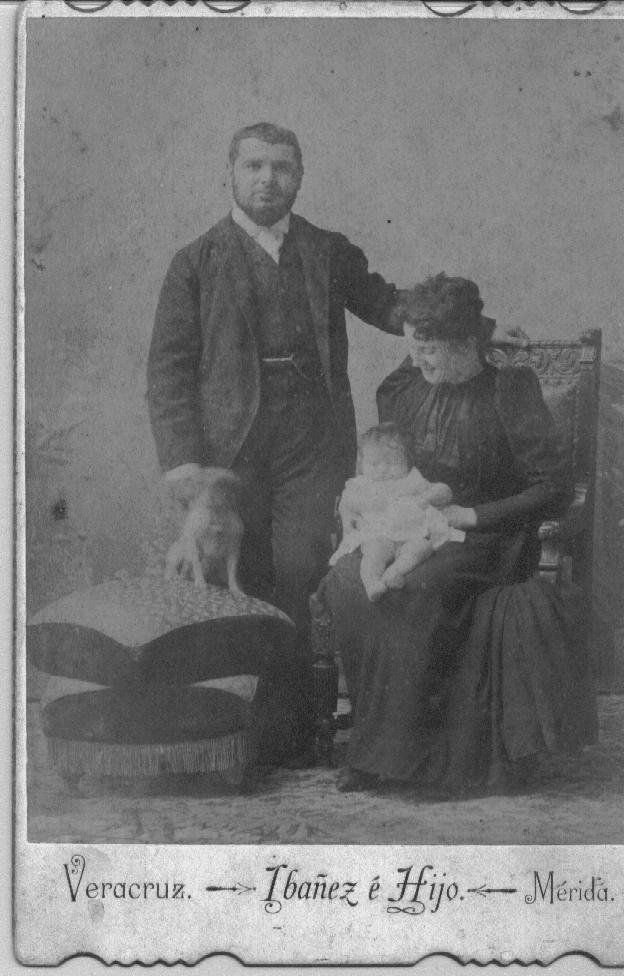 Beatriz's father, Ernesto de Regil, her mother, and her older brother Ernesto. This is the only photo of Ernesto. The pug dog "Tommy" on the cushion is probably the one referred to in the text.
|
At sadder moments my mother would tell us of my older
brother, Ernesto, some 10 years my senior who had died of meningitis at the age of 10
months. It had been a heartbreaking experience for his parents, particularly for my mother
who was, in so many ways, so alone. It had been, indeed, the beginning for her of years of
ill health. "It was so awful to see his head turning from side to side on the pillow
and not be able to help him". She showed us his christening robe of fine lawn and
Valenciennes lace like cobweb, slotted through with satin ribbons now turning brown with
age, also a pathetic bundle of his fine lawn baby clothes. It was at some time during this period of invalidism that mother had a curious experience. She had been troubled with severe backaches and a twisted feeling within her body. The doctors could do little for her and at last, though against her better judgement, she allowed Roberta, the housekeeper, to bring in a 'curandera', an Indian healer or witchwoman. Mother described the feeling of the woman's fingers on her body, firm, competent, gentle fingers probing carefully. There was a sudden pain, than an absence of pain. Whatever had been out of place was righted and my mother was never troubled by it again. My mother was fond of pet animals. Her English pugdog was with her all the time, and once by its barking, brought to her attention a scorpion curled up in the slipper which lay below her hammock. When the Indians on the hacienda heard of her interest in wild things they brought her rabbits and fawns trapped in the bush, and once, a tiny grey squirrel. (There had been a knocking at the door of her room in the dim hour before dawn, and when she opened it an Indian, on his way to work, had put the tiny creature into her hands.) She also raised chickens in the inner patio and sold the eggs. This was a strange hobby for the wife of a wealthy man, but, for some reason, no money was ever entrusted directly to her. She could order whatever she liked and in any amount, but the bills were sent to my father. This, I have been told, was because he mistrusted her where her own family was concerned. He was afraid she would be asked constantly to pay for this or that. Whatever the reasons, she deeply resented this state of affairs so decided to earn her own pin money. I have two simple chinese rice bowls which she treasured till her death. "I bought those with the first money I made from my hens", she once told me. Life in town was varied by weeks spent at the plantation. Here mother learnt to cook, out of sheer homesickness for English food. Armed with a deliciously lush edition of Mrs. Beeton (complete with lithographs) she taught herself all manner of intricate dishes, and discovered apt pupils among the Indian kitchen boys. She even decided to cure ham, but this effort was doomed and produced only a terrible smell as the meat decayed instead of curing. Among her triumphs was the production of French fritters, little golden, crisp balls, airy as soap bubbles, which were eaten with honey made by wild bees. These months on the hacienda had a great influence, I believe, in forming my mother's character. Part of her mature charm was her ability to adapt herself to circumstances. She had a certain mobility which contrasted greatly with most people of her generation who were bound by convention. She knew the rules well enough, but she also knew that at times one had to seek out solutions of one's own. When she came to Yucatán, Mother knew only a few words of Spanish. My father, who had been educated at the Jesuit school of Stonyhurst, in England, spoke English, as did Perico Regil and a few other young men who had been to Beaumont. But none of the young women spoke it, and my mother was forced into months of silence because she was too shy to use her faulty Spanish. Then one day, quite suddenly, it burst upon her that she could speak it! She must have had a keen ear for inflection and turn of sentence, for she not only spoke Spanish, she spoke it beautifully, and she wrote it with style and grace. In spite of her natural English reticence she made many friends among people of all ages and conditions. Among the most devoted were tia Felipa Fajardo and handsome, vivacious Josefa Regil, Perico's sister, many years her junior and whom she had at first characterized as "an impertinent child". Courtly Don Alvaro de Regil admired her greatly, and gave her a turquoise ring with which to grace her "manos, blancas como las de una condesa". The servants were her willing slaves. I believe she had learnt tolerance by the unkindness which had been inflicted on her and the art of listening because for so long she had not been able to speak out. People poured out their troubles to her because they knew she would listen and never betray a confidence. She was one of the few foreigners to be completely accepted by the family -(more accurately, by the clan)- yet somehow she managed to retain her identity as an Englishwoman. She seemed quite at ease in either of two worlds, the English and the Mexican, yet carrying to each something of the other. My own awareness of her came when I was about four years old, and my first memories of her are not in Mérida but in London. My father's death in 1903 had placed her in a very difficult position. Her health had been quite restored by a trip to Europe in 1900 (on which I was born in 1901) and she had come back to Mérida prepared to live a far broader life than before. The Quinta, the charming villa my father had built for her on the road to Itzimna, was almost finished and my father had decided to buy as well a house in Mexico City so that she could escape the hot Mérida summers. He had heard of an attractive small one on the Paseo de la Reforma, not far from the house built by his cousin Perico. (I have often passed by it, a smallish, comfortable looking place set back a few yards from the avenue and shaded by two great mimosa trees.) It was in Mexico City in April 1903, when making the last arrangements for the purchase, that he was stricken by what was then called "vomito negro" and which I believe was some form of intestinal blockage, and he died a few days later, in great pain, at the home of his sister Joaquina who was married to Tomas Viamonte. My mother, who was in Mérida, was stunned. Not only did she feel her personal loss, but she was catapulted into a strange and difficult position. As my guardian she became entirely responsible for the very considerable fortune my father left me, and yet she knew nothing at all about the management of the haciendas which were the source of this wealth, and almost as little about managing the daily household expenses. No money had ever passed through her hands, except what she made by the sale of her eggs and chickens! As an Englishwoman she naturally wished to see me educated in the English manner, but on the other hand it was up to her to see that I was brought up to shoulder the responsibilities which would be mine when I grew up. And those responsibilities lay in Yucatán. Her objective was clear enough. I had to be at ease in Europe and yet love and understand my own land despite its provincialism, its remoteness from what seemed to be the cultural stream of the world at that time. She came to the decision that those ends could best be accomplished by living part time in Yucatán and part time in Europe, two years in the former followed by a year of travel. The family counselled her to sell the Quinta and settle in the town, perhaps sharing a house with some relative. Old tio Joaquin Peon pointed out that it was not seemly for a beautiful young widow to live alone in the backwoods, as it were. Politely, but firmly, my mother pointed out that she was hardly living alone since she was surrounded by a large staff of trusted servants and that her daughter's Irish governess was also there to keep her company. Besides which, the Quinta was not the 'back of beyond' for it was on the outskirts of a very respectable village and the land surrounding ours belonged to very respectable people, including many kinfolk, all of whom were building, or hoped to build Quintas (country villas) too! Thus did my mother break with old established custom, but she did it with so much tact that within a year or two it was considered the most natural thing in the world to live on the road to Itzimna - and tio Joaquin never batted an eye when his pretty Maruch, widowed and with two baby daughters, went to live in Spain by herself. My English education started with the arrival of my first governess, Miss Cogan. She was an Irishwoman, pretty in a pinched way, and very pleasant. She seems to have got on well with everyone. For me it meant settling down to the routine of nursery life after a period of delightful spoiling by the servants. A Mexican child is brought up haphazardly, as the spirit moves. He is never stinted of love, whatever other undesirable features his bringing-up may contain, such as late hours, adult diet and an overdose of doing his own will. Under Miss Cogan, my upbringing was the opposite of all this. Everything was done at a fixed hour, food was plain and wholesome, lessons were part of each day. My cousins thought this very austere, which it was in its way. Since we were very wealthy my mother could allow herself the pleasure of always having the best. On her European trip, at the time I was born, she had given rein to her natural desire to own lovely things. She had good taste, which she cultivated by visits to museums and galleries, and in her personal adornment she had a natural elegance which she indulged by becoming a patron of Paquin, the great Parisian dressmaker and rival of Worth. My own good clothes she had made by a famous children's outfitter in Paris and these were generally of lawn or linen trimmed with handmade lace and tiny tucks. For every day my dresses came from London, practical linen smocks in blue or pink or "Holland", an unbleached light tan material. Silks, satins and imitation laces were all "out", so were bright colours and jewelry. I had two lovely religious medals of gold set with tiny diamonds, and a string of small corals, and these could be worn to parties and on Sunday. But on weekdays, no trimmings of any kind, and never any rings, brooches or earrings. (I was I think the last girl of my generation brought up to believe that her first ring should be her engagement ring!) I had what every child longs for, ponies, a pony cart, pets, toys, books; but all of these had to be put to a disciplined use. I could ride my pony, but only at the hour convenient for the orderly running of the household. I had servants to wait on me, but my whims were never allowed to encroach on their fixed duties or free time. In some ways, Mother had planned a semi-royal mode of upbringing, in others she was years ahead of her time. For instance, my free time was my own, entirely mine, with little grown-up supervision, and certainly no grown-up interference in matters which did not concern them such as, what form my play should take! In the matter of books... My physical wants were looked after by Miss Cogan, Roberta and Dominga, but for some reason it was Mother who administered all medicines and spankings! Why these two had been singled out by her I do not know. Miss Cogan dealt with my misdemeanors by standing me in the corner, or, when I was able to write, making me 'do' so many lines in my copy book. But though my mother was not there physically to get me bathed, dressed and fed it would be absurd to think of me as apart from her, for her thought for me was all-enveloping and all-pervading. Nothing that was done for me by others but had been planned by her. When I was ill, with one of those sudden rises in temperature which afflict children in the tropics, Dominga might bring me my tea and toast, but it was my mother who had found out which tea set I most fancied; who had decreed the exact number of slices of toast and the amount of butter to go on each. My days might be monotonously predictable, but every little pleasure that rippled the surface of the too-still pool had been thought of and contrived by her. So the bond that was forged between us was a bond of the spirit so close as to be almost unbearable. Even at the age of five I was tormented by thoughts of what life would be like without her if she died, a thought brought on by seeing a picture of the parents of the Babes in the Wood on their deathbed. I remember Miss Cogan once asking me why I was crying and of having to concoct a white lie because I did not want to tell her the real reason. My hammock was slung in my governess' room, where, in deference to her nationality, a hard little bed had been placed for her to sleep on. My mother's room, at this period, was next door, and we had to pass through it as we tiptoed on our way to breakfast. This lack of privacy in Mérida houses was a constant shock to foreigners; but oddly enough my mother, who never got over her dislike of the freedom and coarseness of Spanish conversation, did not seem to mind this intrusion. She later moved to the "new" wing of the house though I cannot remember at what date. I loved being with her when she dressed or undressed. Her clothes were so beautiful especially the underthings of filmy handkerchief lawn exquisitely embroidered, which were made for her in France. At night she wore the native huipil, of which she had many, all with intricate cross-stitch designs at neck and hem. She would plait her long black hair, which was full of auburn shadows, into one braid which lay like a heavy rope down her back. Her dressing table was cluttered with little boxes of silver and with heavy tortoiseshell combs and pins, but there was a dearth of cosmetics. She never used rouge (her skin was soft and flawless and of a healthy white, her cheeks lighting to a pale pink when she was in a cool climate) and lipstick would have been unthinkable in that era. She did, however, use powder. Her hands were exquisite, with long slim fingers and nails which grew in a perfect almond shape. She never needed a professional manicure, but would file her nails with emery board then buff them to a delicate shell pink. She attributed her flawless skin to a perfect digestion and to sulphur soap! (This was an evil smelling thing she had sent out to her from England). Every morning on awakening she would drink a glass of water mixed with the juice of half a lime and this was held accountable for the sparkle in her eyes. It is difficult to analyze her beauty which was composed of so many intangible things rather than of perfection of features. Her hazel eyes were too small, but they sparkled, her lips too thin, but they recorded the fleeting beauty of her smile. Her nose was perfect, slightly aquiline, graceful and aristocratic. She was completely un-English in looks, but what was she? I have found traces of her in Greek statues, Spanish paintings, Mexican madonnas, portraits by Sargent and the photographs of late Victorian Russian Royalties. Because she deliberately shielded me from close contact with what she disliked and mistrusted in Yucatán, a rarified atmosphere was created around me. I was cut off from the companionship of many children, including kinsfolk, so Mother felt an obligation to supply me with playmates whose parents best fitted in with her ideas for me. Nena Regil, daughter of Perico, occupied more or less the same position as I did. She also had a governess, and already possessed some of the English 'polish' which set her apart from other children. The Arrigunagas, whilst completely different in up-bringing, were stamped with an aristocratic mark which was unmistakable. So were the Camaras and the Juaneses, who formed the outer perimeter of my small social world. When I say 'aristocratic' I do not mean snobbish or proud. I mean, rather, that our group had a higher standard of appreciation and a broader outlook, which included also an insight into the moral obligations of wealth. Whilst the political turn of events of the last four decades kept the men of our group out of politics, which they qualified as dirty, they still felt a deep obligation to help in all manner of good works, both spiritual and cultural. My mother differed from them on one important point, however. She could not look with approval on the system of labour which prevailed on many of the plantations and which she classified as "slavery". True it was not slavery in the ordinary sense of the term, when a man has right over the body and soul of a fellow man, but it embodied a curtailment of freedom and of the right to a free choice of work and place of work which my mother found most repugnant. The same applied to the condition of the household servants, particularly the women. In our own plantation and in our home this system was mitigated as much as could be, and from my earliest childhood I was taught that all men should be free. However, Mother did approve of the Yucatecan tradition which included all those living under one roof, immediate family, kinfolk, servants, in the all embracing idea of a household or family. She felt responsible for the well being of the entire group, and the joys and sorrows of each individual became part of the experience of the group. "No man is an islande".... I have always felt thankful for this side of my upbringing. Our little social group whilst serious was also full of fun. The grownups dined and lunched together, progressed from malilla to whist to bridge, visited, went on excursions. It was a very pleasant life. Tio Enrique Camara and tio Melo Arrigunaga were great wits. They had both spent years in France and had absorbed some of the pleasanter characteristics of French culture. Tio Perico was English in manner and way of life. He was an austerely religious man, something which produced skirmishes between him and my mother who was more tolerant and gentle. I remember how she battled for my birthday party the year the great day fell on Ash Wednesday. tio Perico was for total cancellation, my mother for holding it on Sunday, therefore out of Lent. Theologically, I believe, she was right, but Tio Perico did not believe in any mitigation! The Portuondos were another delightful couple. Pert Josefa Regil had blossomed into a handsome, witty and charming young matron, with a contagious interest in everything; Aurelio, her husband was a Latin American version of the best of Wall Street, a cultured man, appreciative of the good things of life in the modern world without forgetting the basic virtues. We children liked him because he treated us with a certain kindly deference. Julian Aznar and his blue eyed wife Camila, and Gabriel Arana added an aristocratic Spanish touch to the group. They were quite energetic and would come to play tennis or croquet in the late afternoon, rather than cards with the evening group. Dinner parties were frequent affairs and Mother always dressed up for them. Paquin had made her beautiful gowns of filmy black, some touched with silver or with superb antique lace. During her early widowhood my mother had discovered how lovely she looked in black or black and white, and these became her trademark, as it were. One dress I still remember quite vividly, an Empire gown of black chiffon over black chiffon, over white! Between the two layers of black, delicate garlands of roses had been embroidered in silver bugles and silver ribbon. The dress had a long train, held out by delightfully rustling pleated taffeta frills. With this dress she wore a sautoir of pearls, pearl and diamond earrings, and diamond encrusted combs holding up her pompadour. It was only after her second marriage that she started wearing colours again, though I do remember a lavender satin evening gown which must have come before this event (perhaps as transition from mourning). Afternoon visitors at the Quinta were numerous and ranged from the very poor, such as workmen, old servants and other dependents on my mother's generosity, to the Bishop and Archbishop. Bishop Mejia was a gentle old man now living in semi-retirement at the seminary. He was a family friend and my father had been his pupil at the Institute Catolico. I, myself, had been the first person confirmed by him after his consecration. Mother disapproved strongly of infant confirmation, believing that the Sacrament should be received when one stepped out into the battlefield of life, but she could not resist the request of her old friend. Archbishop Martin Trischler was quite different, plump and rosy, betraying his German ancestry. He was an affable, prudent man much loved by his flock (though Mother and I, in later, revolutionary days, felt he lacked the fire that might have inspired us at that particular difficult time). I enjoyed the visiting prelates, and they enjoyed my mother's tea. My shyness at having to kiss their rings and curtsy was offset by my curiosity to examine the beautiful gold-set amethysts at close quarters. My cousins considered my mother very glamorous. She was understanding of very young people and always took them seriously. Added to this she was not addicted to kissing and hugging them, nor remarking on their growth and personal appearance. She liked certain children very much, as individuals, but she never became sentimental over children as a segment of society. Her eyes were wide open, and she liked people in spite of their peculiarities, never putting them on pedestals, a position both uncomfortable and untenable. Closest to her heart were Nena Regil, the sweet, intelligent child with tremendous depths of feeling and tall, skinny impetuous Minta Arrigunaga, the perfect tomboy. Only my mother saw in her the lovely, tender woman of later years. Mother did not play with us, but we played with her. She would invite us to join her grown up pursuits and during quiet sessions after lunch led us from Old Maid to Canfield, from vingt-et-un to Bridge--even to poker! It must have been funny to watch our under-10 Bridge game. At other times we were invited to help her make cakes and we would stand around the pantry table watching her beautiful hands whip up the seed cake or Bath buns for tea, or we would help her shred bitter oranges for marmalade. At other times she would take us to see something interesting or beautiful, or let us help her in turning out the linens and china closets, or talk to us about things she had seen in Europe. She was deeply religious, but after her fashion. Her course was as different from that of tio Perico with its austere, punctilious observances, as it was from the frivolity of those ladies who attended twelve o'clock Mass to see and be seen. As a young married woman she had risen early and gone daily to five o'clock Mass in the Cathedral, or wherever suited best, but at the time of which I write she lived too far from any church to make this practicable. However, she frequently stepped into the Cathedral on her daily visit to town, either to hear Mass or to spend a few minutes in prayer. (To the end of her life it was her practice never to pass by a Catholic church without going in). In her life this took the place of formal prayer at set intervals. We did not assemble the household to say the Rosary, as did tio Perico, nor did we (except in the nursery) have morning and evening prayers. I think my mother had a horror of 'mechanical' prayer, and of prayer offered under compulsion. But I remember books of devotion left around haphazardly in her room or wherever she might be sitting, and I feel certain she picked them up to read at intervals during the day. She did read a great many books on subjects of interest to Catholics and for her time she was well informed on the more historical and controversial phases of religion. Books by good Catholic writers of the day she displayed proudly and naturally along with other current literature, but she had little use for spiritual 'saccharine' in the form of pious pamphlets and inspired stories. I do not remember her using religious medals either for personal adornment or as a pious symbol; but on the other hand there was not a room in the house which did not boast its Saint, Madonna or Crucifixion, either in a picture or a statue. Her innate good taste made her eschew the tawdry, so that our religious symbols were nearly all antiques (some of great artistic merit, others of the folk art variety) but all helping to create an atmosphere of spirituality in the house. She had a great appreciation of the majesty and magnitude of the Mass, and she was also drawn to the services of Vespers and Benediction. But I never knew her to attend what we speak of now-a-days as 'Devotions'. Sometimes, if we were still in Mérida in the month of May she would send me with my governess to the May ceremonies at the Jesuit church as an onlooker, not as a participant. It was the custom for white-veiled children to go up to the altar after the service taking with them bouquets of flowers which they placed at the feet of Our Lady's statue. I was consumed with envy of these happy young people, of their flowing veils and dresses, their stiff bouquets of flowers and their sweet familiarity with God as they swarmed around the altar. I have never understood why Mother did not wish me to take part. Perhaps it was because of her pronounced distaste for publicity of any sort. Once a year, on Wednesday of Holy Week, Mother made her pilgrimage to Lourdes, the family church, where Bishop Mejia heard her confession, and mine when I had reached the prescribed age of reason. I believe my mother was so filled with reverence and awe for the Holy Eucharist that she only approached the Sacrament because the church commanded her to do so once a year. She would have been horrified at the idea of harboring so Jansenistic an attitude had you pointed it out to her, but the fact remained that she went to Communion only when she had, so to speak, merited so tremendous a blessing, whilst we, in our generation, flock to the altar rail seemingly without valuing What we receive, yet driven by some inner compulsion which makes us cling desperately to the one verity in our chaotic world. It was a sense of reverence which made her put off my own First Communion till I was eleven years old, though my cousins, guided by the wishes of Pope Pius X, had all made theirs some years before. Mother rarely spoke to me of religion, but she put within my reach books suitable to my years and which included stories by Father Faber and lives of the saints. Stories from the Old and New Testaments and the Catechism formed part of my daily schooling. However, what made a greater and more lasting impression on me was the daily and glowing example of her charity and generosity. Her failings were, quite literally, covered over by the mantle of her charity. Small child that I was, I would marvel at the way in which she gave, not only money, but the kind word, the close and interested attention, the friendly advice that might mean the difference between hope and despair to the recipient. After her death a poor and humble person spoke to me about her..."She was not like the other ladies who came here," the woman said, "they were nice and kind, but when she spoke to me it was different. She raised me up to her. I also became a lady." She had a wonderful sense of courtesy and tact towards the poor. Religious conviction and English heritage fused when it came to business practice and relations. "My word is my bond" was her simple answer to the accusation that she failed to extricate herself from a business commitment when another more advantageous one, it seemed, came along. (In this particular instance her integrity brought a rich temporal reward as the firm to which she had sold the henequen crop was so delighted with its quality that they decided to pay a bonus on all henequen raised on our plantations). She could not understand the over-shrewd business deal, the slick operator, or the amassing of wealth for the sake of wealth. She was never foolish in her expenditures, but she spent freely where it would do good or bring happiness. Looking back now over the years I find I like her brand of religious thought. She must always have been very close to God. And lest you wonder how I know these things about her, let me remind you that I was a very observant child, a very silent child. What I saw and heard, particularly as it related to Mother I gathered to my heart, and I have pondered over it over my lifetime. Whilst my evaluations may not be those made at the time by the child who learned these things, they are the outgrowth of them |
Ernesto de Regil's birthday and the day he died are copied from a memorial in Mérida.
This page was last updated on Sunday, April 11, 2004.
This page is maintained by Ben Muse of Juneau, Alaska at benmuse@alaska.com .