Uayalceh
|
|
|
The pictures on this page were taken at Uayalceh in October
1994. This one is of the front of the main house. Beatriz remembered the "vast pile
of colonial masonry and the somber beauty of the dark green 'laureles' which shadowed
it." The front faces a courtyard with an old, large, round water trough in the center. You can't see it here, but across the court from the front of the house is the factory where the henequen was processed. |
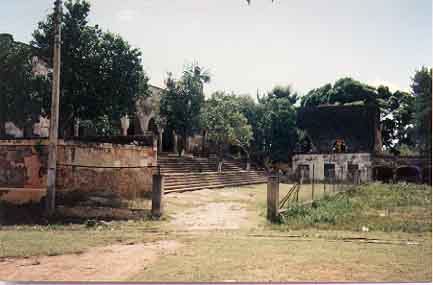
| This is another picture of the front of the main house - from
another angle. The picture above was taken from near the top of the white area on the
right of this picture. There is a low wing of stables running out from the main house at
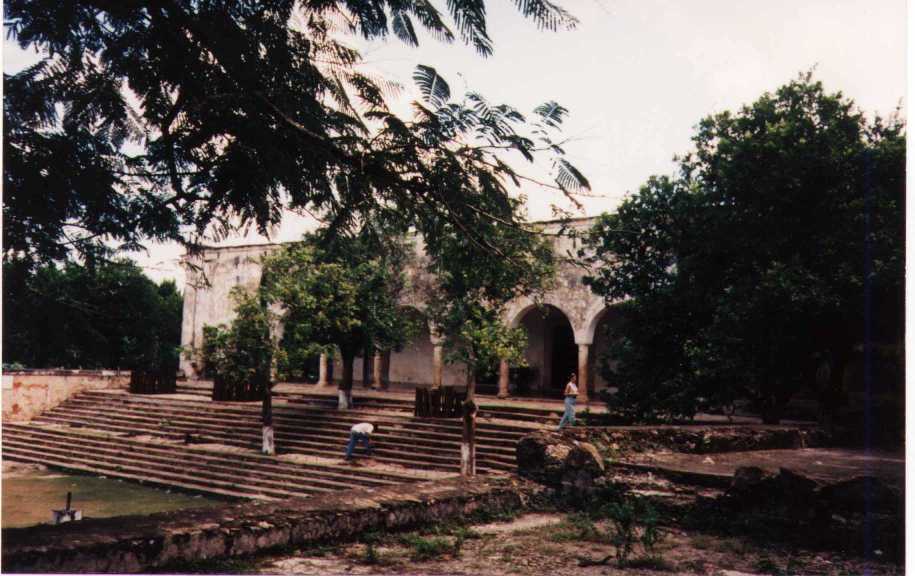
the far right of the picture. There is a more detailed picture of these below. The henequen factory is shown in the picture below. This is across the courtyard from the front of the main house. It may be that John Lloyd Stephens approached this house from this angle on his visit in 1839. He "dismounted under the shade of noble trees in front of the house, and ascended by a flight of broad stone steps to a corridor thirty feet wide, with large mattings, which could be rolled up, or dropped as an awning for protection against wind and rain."
|
 |
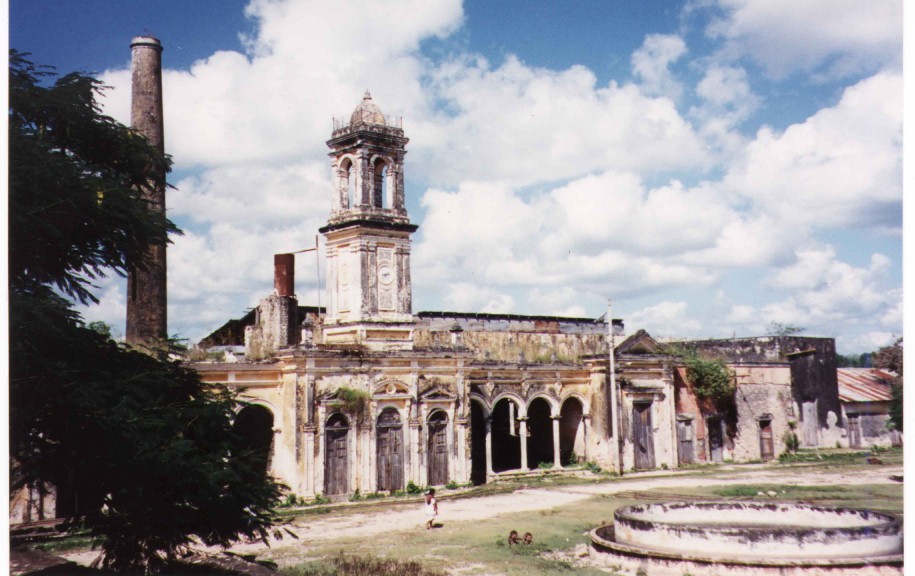 |
This is the factory where the henequen was processed. This factory wasn't here when Stephens visited in 1839. Stephens did say that the owner, Don Simon Peon, had recently built "a shed for use as a ropewalk for manufacturing hemp raised on the hacienda." That was certainly not this building. Stephens would have mentioned something this impressive. Moreover, the architecture of this factory indicates that it was built later in the century. Jack Barber mentioned the bell tower on his visit in 1914. |
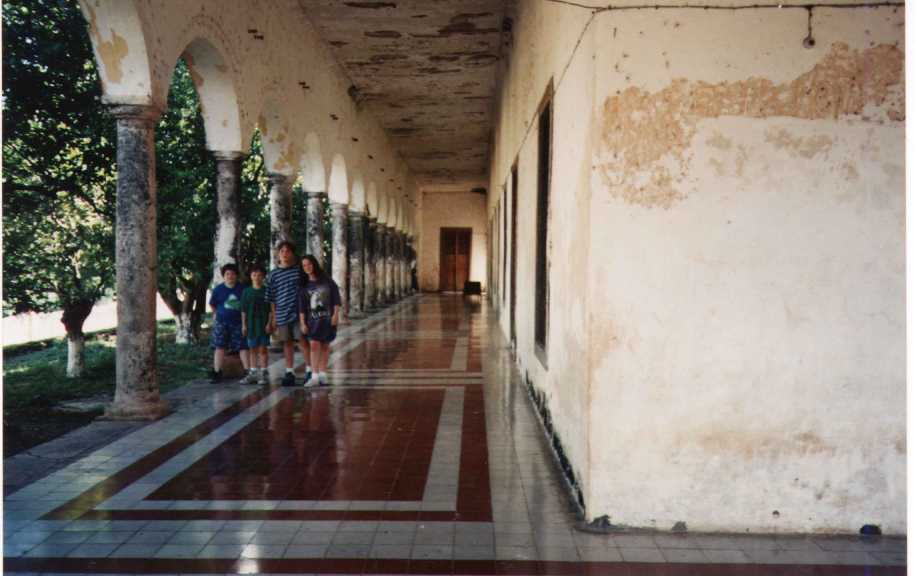
| When John Lloyd Stephens visited in 1839 he mentioned how the
corridor across the front of the house "continued around the building" as shown
in this photo taken from the front. As an old woman Beatriz would still have vivid memories of this corridor. She was able to "close my eyes and feel the cold, rough surface of the thirteen stone pillars" which supported the arches. Her mother's garden must have been in the green strip just to the left of the corridor in this picture. The door to the dining room is at the far end of the corridor. She would also remember the corridor at night: "...I well remember the gentle and beautiful light given by the lamps. By its glow we would sit in the great corredor looking out on the splendid tropical night and listen to the sound made by the wind rustling through the coconut palms -- a very special and beautiful music. The village was all quiet, though sometimes a dog would bark, a horse whinney, or one might hear the soft pad-pad of an Indian's sandalled feet -- the sound of Silence --"
|
|
|
This series of rooms runs "shotgun" style the length of the main house, parallel to the outside corridor in the picture above. The last door leads through to the kitchen and dining area. These were probably public rooms. Each has a door to the outside corridor and each has a door on either end that leads to the adjoining rooms. |
| This is the door to the chapel. Stephens described the chapel door as having "a large cross over it." The cross isn't here in 1994. Beatriz described the entrance: "The entrance portal was of carved stone and quite impressive..." |
|
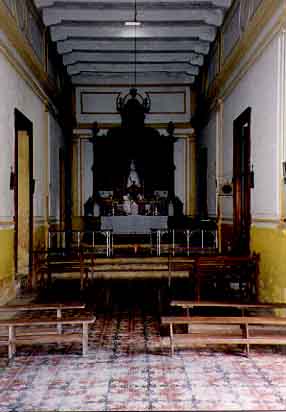 |
The inside of the chapel. As Beatriz wrote, " the chapel itself was a long structure – very plain – with a simple altar and retalbo of wood at the far end." |
| This is the area at the back of the dining room. The door to the dining room is on the right. Behind Ben Muse is the open corridor between the kitchen and the dining room. Hives of wild bees were kept in this patio as well as live deer given to Beatriz's mother by Indian hunters. Jack Barber fed the deer here on his visit in 1914. In the kitchen Beatriz' mother taught Indian boys the secrets of French and English cooking. | 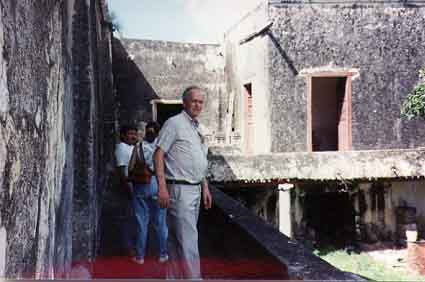 |
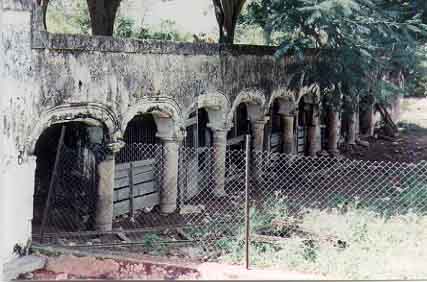 |
These were stables. This is a low wing of the main house. It bounds one side of the courtyard between the main house and the factory. The pictures above, of the front of the house and of the factory, were taken from the roof of this wing. In 1914 Jack Barber saw orange trees growing behind the parapet above these stables. |
| Here is one of the railroad wagons used to move the henequen around. | 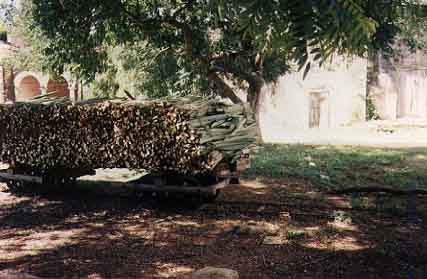 |
This page was last updated on Sunday, April 11, 2004.