Young Paul Gleadell
| Paul talks about his life as a boy and particularly about Yucatán. He didn't title this chapter. | My passport states: "Date of Birth –
23rd Feb. 1910, Place – Jalapa, Mexico". This unusual occurrence took
place at my mother’s house on a hill overlooking Jalapa, and the highlands beyond,
under the benevolent gaze of a volcanic mountain, Cithalrepetel (5,295 metres) meaning
"The Mountain that shines like a star". It was a quiet spot, and the sounds I
can remember are of donkeys braying and cocks crowing in the early morning from away down
in the valley. There was no carriageway to the house, and the approach was up a steep path
from the little mule-drawn tram that trundled up the valley from the town. Baggage was
carried up on the backs of porters by means of cloth bands around their foreheads. The christening was at the pleasant little white-washed church of San Jose, just off one of the narrow twisting streets of this typically Mexican town. My parents, in their wisdom, gave me only one name, and for this I have been grateful to them for ever after, the time I must have saved in form-filling – a constant preoccupation of the human race it seems – can be considerable. My relationship with my father was not, in later life, of the easiest. There was a gap of 45 years between us and the after effects of wartime gas had sharpened his irritability. And for my part, I was quite a ‘porcupine’. His experience with my Baker uncles caused him to be ever on the alert for similar characteristics in me and, a lone male himself among sisters, he was adamant to ensure there would be no "mollie coddling" for me at the hands of my many female relatives and attendants. When he read my first term report from Sandhurst, he was so alarmed that he wrote to my company commander to ask whether it would be better for me to be removed from the Royal Military College. Nevertheless, I had a healthy regard for him and I would leap to his defense if I heard him criticized, even if it were in jest. All in all, he treated me strictly, critically, but generously and fairly. My mother I adored, as practically everyone who knew her did, and it seemed to me in keeping with her way of life that, on her maternal side, she was descended from a family – the Jeffreys of Wiltshire – who had kept their faith throughout the penal times and beyond. She spoke to me mostly in Spanish, even in reproof. "No seis pesado" (don’t be tiresome), she would say softly when I was being too forward with my own opinions. I could not bear to see her hurt, and when my ‘porcupine’ had got the upper hand I would retire to my room and weep remorselessly. When I returned to school after holidays, I would be homesick, not on my account for I was among my friends and the hurly-burly of reunions, but because I pictured her, quiet and alone, in our big house. My half-sister Beatriz, was nine years my senior. For inexplicable reasons she took infinite interest in me and understood me pretty well. When our mother died, to her I would let off steam and lift the curtains from my sensitive feelings. Invariably I would receive wise counsel in return, expressed in an understanding and helpful way. After all, she was a "double first" at Cambridge! I am not alone in believing the world of literature to be the poorer in that she never pursued a natural bent as an author though pressed by many, including the publishers, T. Fisher-Unwin, to do so. Her letters have always been a joy to read and re-read by her relatives and a wide circle of friends in many lands. It was typical of her many acts of thoughtfulness to decline a third year at Cambridge in order to be with our mother during a lonely period at home. When we left Mexico, as refugees from the revolution, we were to spend most of the World War I years at Manor Lodge. The countryside, by then was very far from beautiful, but I found compensations. The Lamplighter on winter evenings turning up the street gas light opposite the nursery window. The Scouts marching past to church on Sunday mornings. The river Mersey, with many ships newly camouflaged for war; I waved to the ferry boats Iris and Daffodil unaware that they were on their way to the memorable Naval action at Zeebrugge. The close proximity of my relatives and the annual pantomime in Liverpool we all attended; excursions with my mother when she would take me by train or ferry to some undisclosed destination. |
||
|
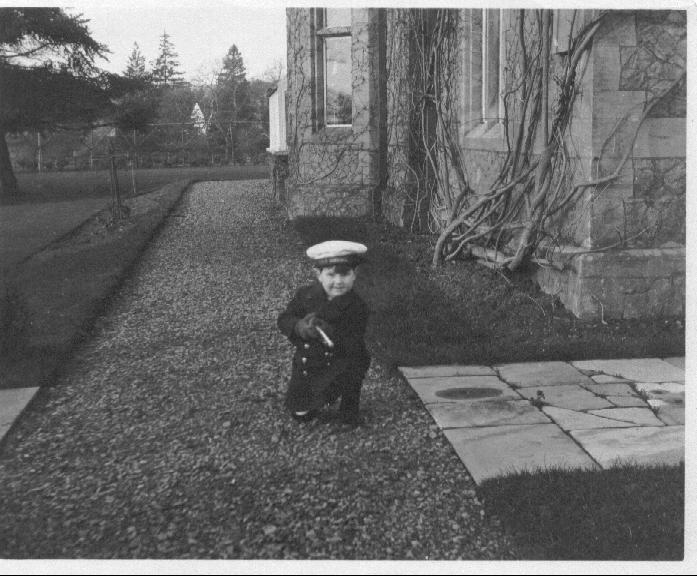
I dressed in a sailor suit at first – but
not the commonplace rig of a child. The first day of May saw me insisting on the white
cover to my cap, whose riband, in the interests of security, revealed only ‘HMS’
or "HM Submarine’; trousers had to be fully bell-bottomed and, when I satisfied
my own advancement, the badge of Torpedo-gunner’s Mate on the arm. It was a sad day,
later, when I realized that lack of maths would preclude me from joining the Royal navy or
the White Star Line. I thought instead of a tram-driver and even of having a stab at the
Papacy. When our doctor asked me what I really wanted to be, I said, "Something
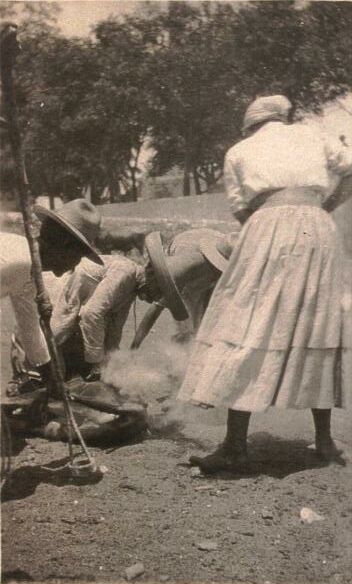
retired, with a pension". That, at least, I have achieved. I attended a preparatory school, Summerville, at New Brighton through which all my cousins had passed. To get there I would take a tramcar after breakfast and again after lunch and walk the two miles back each time. I had a nice French governess, Cecile Pilicier, and to her I own my qualifications as an Army interpreter many years later. I attended stern Miss Maddox for pianoforte, sprightly Miss Jackson for ballroom dancing and dear old Herr Heinecke (a naturalised Englishman) for German, but alas, in these arts I reached my ceiling all too soon. And there was Dominga, my mother’s tiny plump Yucatecan maid of uncertain age, whom I announced I would marry. At the end of the war Manor Lodge was sold and we sailed in the ‘Celtic’ for a visit to Yucatán, together with Mlle. And Dominga. The Johnstons and Barbers left the district too; the former to a fine big house, Mérida, in Noctorum, and the Barbers to Ridston, both within reach of their work in Liverpool. In my boyhood, it was Yucatán – Mérida and the haciendas – that made on me the greatest impact. In those days, and perhaps now, few people seemed to know where or what was Yucatán, so it deserves some description. Indeed, together with the neighboring Campeche and the untamed District of Quintana Roo, it was remote even from Mexico itself and was once an independent Province. There was then no road, rail nor air communication and the only means of getting to the United States of Mexico was by steamer from Progreso. To the little seaside town of Progreso, therefore, we would come, but the waters were so shallow that anchor was let go six miles out from a mile-long jetty to which we, and all freight, were conveyed by steam launch and lighter. In recent years, Sisal, a few miles along the sandy coast, has been developed into an all-weather harbour for trawlers and yachts. Mérida, the only city of consequence, lay an hour away by rail (there was then no metalled road). The Yucatecan countryside has no claim to beauty being mostly flat with no surface rivers; water was raised from underground rivers by means of "veletas", metal windmills on tall light-steel structures. Mérida, seen from a roof top or from afar, was like a city of windmills. Almost the only vegetation of the countryside is the mass of scrub jungle, known as "el Monte" and the acres upon acres of the sisal hemp plantations. The henequen plant is like a giant pineapple of cactus variety, greenish-grey in colour with pengas (leaves) four feet long and three inches wide, like broadswords with cruel spikes at the end and sides. They are planted in long straight rows, similar to a regiment on parade. Birds are wonderful; the Yucatecan Turkey of blue, gold and brown, the scarlet Cardinal and the Humming bird that resembles a flying jewel, while butterflies are a perpetual marvel. Mérida was a beautiful city with avenues shaded by Flame of the Forest and bougainvillia, plazas tastefully laid out, imposing churches of some four hundred years and houses – like that of my special friend Alonso-Luis Arrigunaga – dating back to Montejo the Conquistador of Yucatán. On the outskirts the haciendados had built delightful Quintas in the style of the Riviera villa and surrounded by large and well tended gardens. But the town houses in the narrow streets were built in the Spanish-Moorish style around their own patio or garden. The Plaza Grande (Main Square) where stands the magnificent and historic Cathedral, would be the scene of the evening paseo (promenade). Families would sit at their large open windows to watch the crowd outside moving in two circles, girls on the inner and men in the reverse direction on the outer; communication was by the eye and not by speech nor touch! Later, perhaps, some gallants in the picturesque dress of the ‘charro’ would ride round to serenade some beauty with guitar and song. I was too young to play this game, but at the Carnival and Battle of Flowers, I would be togged up in some unusual garb and, with friends, drive up and down the long Paseo Montejo. But it was to the haciendas of Uayalceh and Sotuta that I would hurry at every opportunity with Don Absolón Vasquez, the portly Administrador with the panama hat. Leaving the train at the wayside station of Temozón, one found a narrow gauge decaville track on which, a-waiting, was a home-made tram drawn by a couple of mules. For four miles this little line ran through the Monte (where ambushes have occurred) and then ran along the hemp fields (planteles) until it emerged into the neat village of white oval shaped thatched huts. Entering a narrow avenue of heavily laden orchards – oranges, lemons, bananas, coconuts, zapotes – and then the high wall of La Casa Principal, it drew up finally in the plaza. The house was a large imposing, one-storey building in a Moorish style and flanked on two sides by a handsome colonnade of arches. It stands on an elevation of some 20-ft and the front is approached from the plaza by a magnificent flight of steps, intersected by orange trees and running the whole length of the front. Facing it, across the plaza, was the Machine House with a clock tower that chimed a mellow and haunting strike. Along one side of the plaza was the large chapel and then a raised boardwalk, over the stables and from where one could also gaze over into the Corrales where the cattle were brought for counting and branding. The day of the Fiesta of Santa Catalina was a memorable one; my mother’s name being Katherine, Santa Catalina was adopted as the patron saint of Uayalceh. It started with Mass before sunrise, after which the Mayas would pay their respects to her in the approved fashion of kissing her hand. There followed celebrations throughout the day, with a lunch of pork cooked in a hole in the ground and covered with banana leaves. There were lasso competitions (round the legs of the steer as in a rugger tackle, neck jerking being a bad fault) and a bull fight – no harm being done to the bull. The Vacqueros (cowboys) would match their skill by seeing who could close nearest to the animal without his horse being grazed, an event which would be greeted with derision. And, finally, at sundown, song and guitar in the plaza. On other days for me there would be mule plataformas to be driven out to the planteles, helping to load the bundles of pencas onto the rasping machine, day long rides to Sotuta and other neighboring haciendas, bathing in the deep tank and, in the evenings, some instruction in the Maya language from schoolmaster Fidencio. |
||
|
My special mates were the Vaqueros, headed by
Rubio, the only non-Maya on the hacienda. He had been a sergeant in Mexican cavalry, knew
the ‘bandidos’, and could spin a yarn as good as any Devon fisherman. Then there
were the twins, Alejo and Pedro Pech, the wizened-faced Remijio and the youngster Isidoro
Chavez. Chavez once burnt his arm badly in an accident and my mother had taken him back to La Quinta in Mérida to see him properly nursed. Fifty years later I took Mary to Uayalceh and I walked out to the last hut but one of the village. There I found him, Chavez, and his eldest son, and on the wall of his hut just two pictures – one of the Virgin of Guadeloupe and the other of my mother. He recognized me almost at once – "Ah, Polito" – and he led me by the arm around the huts to meet his seventeen grandchildren, none of whom spoke the Spanish. He had no idea at all of his age, nor that of his son, but he knew precisely the names and characteristics of the horses we rode – Marquis, Princessa, Escabeche, El Bayo de Goyo. As I was leaving he said: "Your mother promised to take me to England. Take me with you now". Uayalceh is one of the oldest and largest haciendas of the Province whose original name was "Nuestra Senora de la Asuncion Uayalceh". Records show that it was founded in 1653 by the Spanish Capitan Inigo de Mendoza who purchased a parcel of unproductive land from local villagers and which was gradually increased as the years rolled by. It was first used primarily as a cattle ranch but when sisal hemp was developed, most of the grazing land was taken up for planting the henequen and cattle thereafter became a very secondary concern. The hacienda changed hands several times among the Spanish notables in Mérida and there are records of splendid weddings taking place in the large chapel. Then, Uayalceh came into the ownership of the de Regil family – and of my mother and Beatriz. Today, Uayalceh – like all the great haciendas – is a shadow of its former self. The haciendádo, Alonso Peón, by Government decree can only own La Casa Principal and the machine to rasp the pencas, for which he is paid a little by the Government – when it feels able and inclined to do so. And so it has fallen into dilapidation – still repairable but unliveable – and the machine is silent four days a week. There is a strange silence and there are no longer the joyful gatherings, just a host of haunting memories as a cultural heritage slips away. The land, and what cattle there are now remaining, was given to the workers by a Government devoid of knowledge of the technique of hemp cultivation, but as Isidoro Chavez says "Ay! I am no longer a person, just a cipher", a sentiment echoed by others of the Old Guard. When I left Uayalceh, at the age of 16, I buried something there – and I can never dig it up. La Quinta in Mérida stands as it did the night my mother died there, in good trim with the de Regil crest on the stained glass windows above the verandah, but to it – at the expense of the orchards and gardens – has been added a large complex of modern buildings for it is now a convent school of high repute. During our visit in 1980 Mary and I went there for Midnight Mass, and as I heard the good nuns enchant the Gloria I knew that this would have reassured my mother. When she died I was fortunate to be allowed to join up for a short spell with a small group of archeologists, led by Dr. Sylvanus G. Morley of the Carneigie Institute of New York and which included one Englishman (later Sir Eric Thompson). They were exploring and uncovering the ancient and historic ruins of the Maya civilization at Chichén Itzá. To get there, one traveled by train to Dzitás and on by volán (bullock –cart). We lived in Maya huts and ate tortillas and frijol. The massive ruins were covered, except for the summits, by dense Monte and my inexpert job was to help hack away at the jungle, clear a track to the sacrificial ‘cenote’, and shift the unimportant masonry that had become displaced by the centuries. In the evenings, by the light of a paraffin lamp, I would squat on the ground, spell-bound by the theories advanced by these learned men as to how the Maya race – so Gurkha-like in appearance – had originally migrated to the Yucatán peninsula. There are still many opinions of this as yet unexplained question, varying from an origin in the Far East and crossing by the Behring Straits to a move from North America in search of a climate suitable for their needs. Equally perplexing was why they had deserted the magnificent cities they had built; was it war, drought, famine, disease? This is a chapter still to be written. Some fifty years later I went back to Chichén Itzá to find open and grassy lawns around the various monuments, picnic sites, an airstrip, a broad metalled road all the way to Mérida, and two large luxury hotels with swimming pools. Chichén had become one of the great tourist attractions of the American continent. The Mexican revolutions of the earlier years of this century had brought in their train persecution of the Church which found its way even into Yucatán. Oppression varied in degree from time to time; sometimes in Mérida just the Cathedral and two churches were allowed to function on Sundays; at others, a ratio of priest to population, totally inadequate, was permitted but not in clerical garb when outside the presbyteries, and at worst, vandalism of all the holy places. Priests were then smuggled into private houses at dead of night to say Mass, and our Quinta and grounds were once thoroughly searched by suspicious police, notwithstanding a notice which boldly said, "This property is English". So it was with interest that, fifty years later, I counted on the front page of the public telephone directory 60 churches in Mérida alone, providing 187 Masses on Sundays and 100 on weekdays, most of them well attended and there were over 80 students at the Seminary. I asked what had brought about such a changed situation since I had lived there. I was told three factors: the courage of the Archbishop and his clergy, many of whom had gone underground or to gaol, the efforts of the young people of all classes in keeping the Faith alive and, naturally, the intercession of the Virgin of Guadeloupe. There had also been a material factor. When the churches were closed, the senior citizens organized a boycott on their petrol driven engines; in place, out came the carriages, the horses, the cycles, thus adversely affecting Government revenue. So the citizens told the Governor that as churches were re-opened, so would the boycott be lifted. Perhaps there is a moral in this for us, who live free of persecution but where lethargy and materialism have become factors governing our present day society. There is a new generation now growing up in Mérida to whom the legends of the haciendas are a matter of interesting history. They live in small houses or bungalows, practically built, in the ‘Colonias’ around the city and they work in a wider variety of employments. Unlike many of their grandparents who were educated in England (Beaumont and Stonyhurst) or the USA, they have mostly been educated in Mérida or other parts of Mexico. This is partly due to sheer economics and the advanced calibre of local schools, and partly to the hesitancy of parents to put their children at risk in environments where they believe standards in the morality of life have fallen in recent years. One result is that the proficiency of their predecessors in the English language is not evident. But they have inherited the courteous manners of their forebears and the traditional respect, affection and consideration for the elders of their families. Very noticeable is that there has sprung up in the trades and business circles, a considerable number of emigrants from the Christian Lebanon whose commercial acumen has brought them prominently onto the Mérida scene. |

This page was last updated on Sunday, April 11, 2004.