Uayalceh |
|
|
|
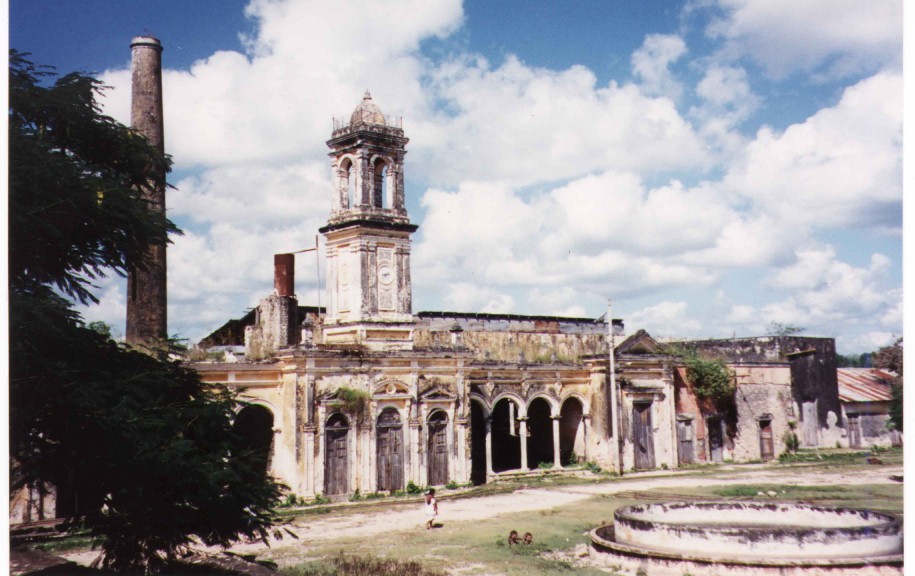
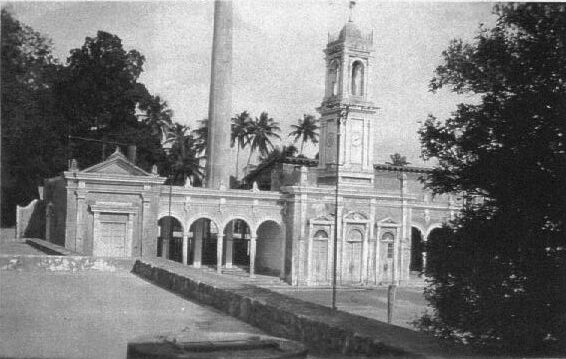
The front of the main house 1920 and 1994. |
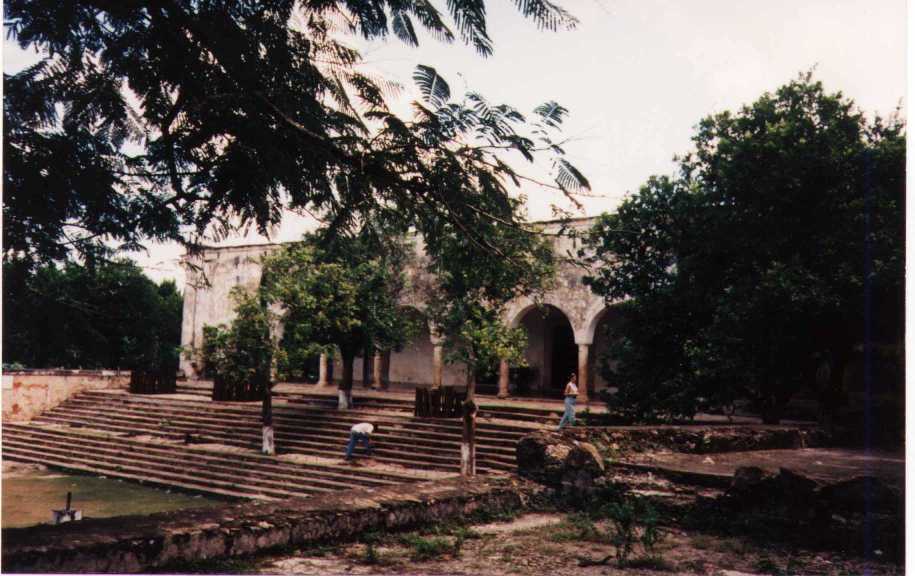
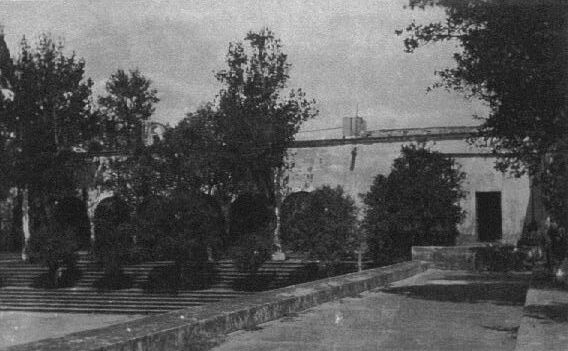
It is impossible for me to find words in which to express what the plantation has meant, and still means to me. I cannot remember a time unhaunted by the magic of this vast pile of colonial masonry and the somber beauty of the dark green "laureles" which shadowed it. I can still close my eyes and feel the cold, rough surface of the thirteen stone pillars which support the arches of the great "corredor" which runs along what was once my mother's lovingly tended flower garden -- (now grazing ground for a small flock of sheep) -- and I can still smell the very individual scent of the dining room, compounded of vanilla, chocolate and the sharp smell of "bagazo", (the residue of the henequen leaves), thrown out into great heaps beyond the cleaning plant. When the wind was in the right quarter a fragrance of orange or mango blossom, according to the season, would be blown into the room.
It was the airiest of rooms, full of windows from which one saw only tree tops and sky. I often felt we were suspended from the sky, as in a giant birdcage.... Our dinner service was charming, a French one delicately decorated with pale yellow canaries alighting on sprays of thistles. I suppose mother bought it when she was in Paris just before I was born -- There was one strange note struck by the tall, willow-pattern pitcher with pewter lid, which was used for the hot milk which accompanied our morning coffee and afternoon tea. I remember I was fascinated as a child by the two little Chinamen about to cross the bridge between one willow-and-pagoda adorned island to another, frozen forever in this attitude of never reaching what they set out for!
At meals, before my mother had the room screened, a small Maya boy waved branches of "ramon" to keep off the flies, and at the evening meal, the mosquitos.
|
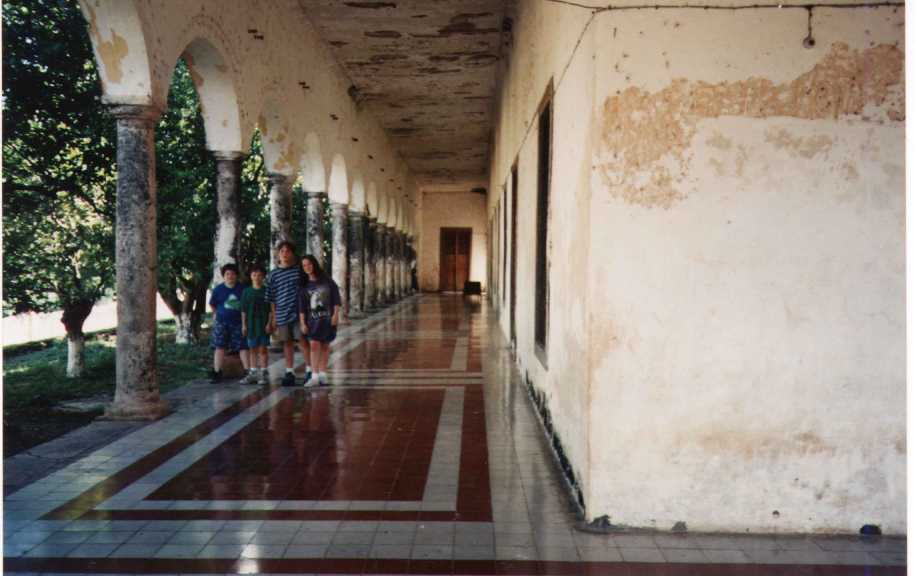 |
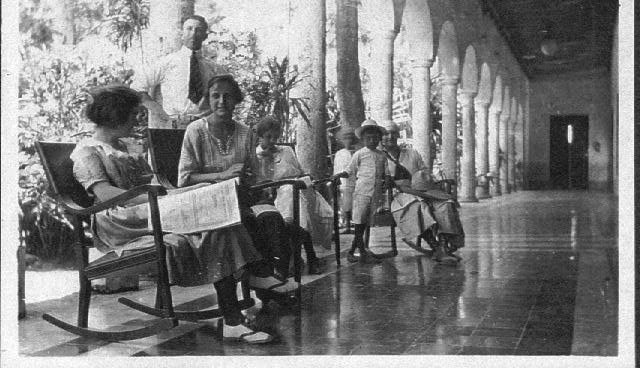
| The corridor along the side of the main house, 1920 and 1994. Beatriz is seated far right in the 1920 photo. The dining room is through the door at the end. | |
The kitchen which was to the right of the dining room and across an open corridor giving on to two small patios, was always full of fine smells, as mother had taught some of the Indian boys the secrets of French and English cooking. They proved apt pupils, even to the making of feather light beignets (fritters) which we ate with honey from the hives of the wild bees down in the nearest patio. Also in this patio were the deer my mother had been given by Indian hunters, who had caught them as fawns. They were beautiful creatures but quite dangerous and we were never allowed to go down the stone steps to the patio to pet them.
In the twenty-five years I was closely associated with the hacienda I learned to love every stone of the old house. We had periods of enjoying great luxury -- such as our own electricity -- and others of being quite primitive, when we made do with candles and lamps. Bathrooms had been installed at the turn of the century, good American fixtures, which worked. Hot water came from the great tanks on the roof, where the water was sun- heated, thus making three p.m. the favorite bathing hour. (In the early morning the water in the shower was distinctly chilly!)
Before the electricity was put in there was the period of lamps and candles which I have mentioned, and I well remember the gentle and beautiful light given by the lamps. By its glow we would sit in the great corredor looking out on the splendid tropical night and listen to the sound made by the wind rustling through the coconut palms -- a very special and beautiful music. The village was all quiet, though sometimes a dog would bark, a horse whinney, or one might hear the soft pad-pad of an Indian's sandalled feet -- the sound of Silence --
I suppose we did nothing important nor earthshaking when we stayed at the hacienda, but we did savour life. The day started early, for at 5 a.m. the Indians were already on the move, either to cut the henequen in the fields or to work in the cleaning plant, or with the livestock. The early morning was good for work, as the air was cool and fresh and scented with the hundreds of aromatic herbs and flowering shrubs which grew in the jungle. After breakfast my mother would start on her rounds of the village and the work, accompanied by Absalom Vasquez, the overseer, who had worked for my father and before that, his uncle, Rafael de Regil, from whom the property had passed to us. Even as a small child I often accompanied them on these rounds, visiting the sick, looking at horses and huts being built or renovated, inspecting the orchards, and so forth. As I grew older I would ride out with the superintendent of the cowboys to see the cattle out in the jungle range and visit the stables where were housed the riding horses, the magnificent English stud, and the brood "she" asses. Uayalceh had a reputation for having the finest mules in the Yucatan - small but very strong - of a lovely pale dove colour, with chocolate touches around leg and mane.
|
|
| The henequen cleaning plant at Uayalceh, 1920 and 1994 - across an open courtyard from the front of the main house. These pictures were taken from about the same spot as the picture of the front of the main house. | |
The late morning hours were spent going over the books in the office, and listening to suggestions and complaints. One of the suggestions on which we acted, I well remember, was to start a village band. Instruments were sent for, and once a week a band teacher from Merida would come for the night and spent the following day trying to extract music from his non-musical though enthusiastic students. They never did achieve musical prowess, but only a "glad noise" which was fine for the many festivals of Saints celebrated by them.
After the noonday lunch, the big meal of the day, came the siesta, a quiet time for reading and sleep, followed by the bath, lemonades and visits from the Indians. At five all work stopped and the men would gather round the big house waiting for the Angelus bell to ring. This coincided with the setting of the sun and the swift coming of the tropical night. Lamp or candle light did not permit us to do much reading or sewing after dark, but it was a time for quiet, at times witty conversation, and my mother was always ready for a game of cards. In my earliest years these were Spanish card games, such as malilla, later we graduated to bridge.
The life of the Indians fascinated me. It has been difficult to define the exact relationship between us and them to my liberal American friends, some of whom insist on classing one as a former slave owner. I can assure our grandchildren that there were no slaves in Uayalceh. I can best describe the relationship as that of a "household," members of which we felt responsible for, much as the head of a clan in Scotland or of a tribe in Biblical times felt responsible for all who bore his name or worked for him. We have also been accused of being paternalistic. Perhaps that was so, but then, I do not think of paternalism as evil in itself, though it can become so when misused. I think that it was even necessary at that moment in history, as a bridge over which people still living by tribal rules and customs could move into the modern world at a safe and reasonable pace.
I do know that, under our system, I grew up with very little race prejudice. I have never been upset by the colour of a person's skin, which is a great blessing, saving one from a lot of imaginary worries. My brother, Paul, nine years my junior, and I were brought up to be punctilious in addressing the elders of the village by their proper title and our mother would have been most annoyed had we spoken of the magnificent Indian who had been head man for many years, as anything but Don Basilio - even as we would have addressed the highest dignitaries of the land. We believed very deeply that before God we were all equal, and this thought did not worry us, as I later found it worried some of our friends in Petersburg, Virginia, if we knelt next to a poor ragged person, or one of another race, in church. Looking back, I feel that we were rather civilized! Perhaps it was not so in all the plantations, but Uayalceh had had a succession of broadminded and conscientious owners, and my mother had added her English sense of justice and fair play to the tradition they had established. By the time I was seventeen I had enough feeling for social justice to enter and win, an essay competition sponsored by the English hierarchy for pupils in English Catholic schools -- and I based my essay on what Uayalceh had taught me.
In 1910 my mother insisted that a school be started in the village and a large room was set aside for this purpose. Two elderly ladies were hired to teach the children reading and writing and it was pleasant to watch them troop up each day to be taught, clad in snowy "huipiles", each child clutching a slate.
The hacienda house was full of fascinating nooks, so well described by Stephens in his Travels in Yucatan, written in the forties of the past century, and among them was the tiny cell under the outdoor stairs leading to the gallery and belfry of the chapel. It had no windows, but the door, which was a heavy wooden grille, let in plenty of air to the prisoner within, generally some gay blade who had enjoyed too many drinks. Serious crime was unknown in Uayalech until much later when the tide of the Mexican Revolution started sweeping over Yucatan in 1915. I remember as a child, watching the village elders, hear a case, and allot punishment -- (so many strokes with a rope). It was more a ritual than an infliction of real pain, and no ill-feelings were harboured on either side. As it was an accepted custom, it was probably better than a month's incarceration in a dirty municipal jail.
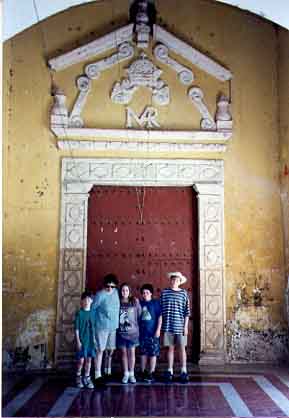
The chapel and the terrace and arcade which led to it formed the right wing of the house. The entrance portal was of carved stone and quite impressive, but the chapel itself was a long structure – very plain – with a simple altar and retalbo of wood at the far end. I do not remember the old altar – but I have been told that the silver tabernacle door which has always hung in our living room in all our homes came from there.
|
The chapel entrance in 1994. |
My mother was in Europe when her man of affairs in Merida - seized with a desire for modernization – did away with all the old things in the church – including the fascinating choir balcony which was cut off from the church by a heavy wooden grille – placed there by a former owner who had a very beautiful wife of whom he was insanely jealous and whom he screened from the vulgar gaze of his friends and the Indians with this screen. I remember it was painted a pleasant [?] green – and while we could see very well through it – no one could see us.
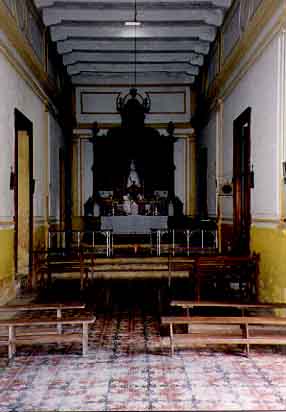
Among the original furnishings which escaped the modernization was the charming Madonna who still graces the altar and is the patroness of the hacienda. There is also a life-sized figure of Christ carrying his cross in the sacristy. The beautifully carved face registers agonizing pain – and there is a crown of real thorns on the head. The angular figure – stooped over with the weight of the cross is clad in a red velvet garment, now faded and torn with age.
|
The inside of the chapel in 1994. |
I must have been about 8 years old when my mother sent me on an errand to the priest who had come to say the Sunday Mass. He was in his room, which lay just beyond the sacristy. It was during the great heat of the day and all shutters were closed – so the rooms were in semi-darkness. I had never been further than the chapel and I rushed into the darkened sacristy and found myself looking into the pitiful face of Christ – our faces at the same level. I was filled first with terror, then with compassion. I never spoke of this meeting to anyone – but in some subtle way it has influenced all my life.
I suppose the statue was carried by the Indians in Good Friday processions – Many years later I found a print in Canul’s shop in Merida of just such an image – Christ walking, cross on shoulder, thro’ a Yucatecan landscape – with coconut palms above him – a thatched hut in the distance.
The arcade leading to the chapel looked down on huge corrals – one of which had been given over to the growing of Sudan grass for the livestock. This tall, cane like plant was kept green and lush by a complicated irrigation system. The second large corral was reserved for the ‘cattle’ when it was brought off the range – and there was a [?] corral, shaded by a huge laurel tree – which served as a maternity ward for the sows. Big wooden gates over which staircases, in the form of Moorish arches, had been built – opened from one corral to another. These arches had been built in the 18th Century and were for the use of the watchmen who guarded the herds by night against attacks from ocelots on the prowl. For some reason the sows and their [?] were irresistible to us children and one day my cousins and I jumped into the corral to pet the squeaking, polka-dotted, little creatures. Like a flash of lightning the mother pig attacked us and we ran helter-skelter towards the great gate. As the fattest and slowest of the children I arrived at the gate at the same time as the sow – and only just escaped being knocked over and trampled on by the infuriated beast. Being chased by a pig is one of the high spots of Life – if one survives.
There were two orchards, the "old" and the "new" – from both of which we garnered delicious fruits and vegetables. The simple and very effective irrigation system kept everything green and luxuriant – even during the long winter droughts. A wide masonry wall was built radially from a central water tank also of masonry. The top of the walls was curved out into a deep channel thro’ which water from the central tank could be run. At intervals metal pipes down the sides of the walls and along the ground carried this water to each individual tree – or to a planting of vegetables. The trees were planted in depressions which held the water run into them from the pipes. This was the way the Spaniards had irrigated their orchards – and I suppose they had learnt the system from the Arabs. It was beautifully simple – anyone could supervise it and there was nothing to get out of order.
The gardeners were mostly old men very wise in their craft. They knew by instinct when to plant – when a fruit was ripe enough to pick – and they could interpret all the signs of the weather. When the dreaded locusts flew towards the orchards in great dark clouds they organized bands of youngsters to beat on gasoline tins and to shout and make a din – so as to frighten off the destructive creatures who could strip an entire orchard of its foliage in a few seconds. We dreaded them as much as we dreaded the vampire bats which would suck the blood out of our horses and cattle. The bats lived in caves in the jungle - hanging from the ceilings of dried out cenotes – at sundown they would come out and flutter madly in the cooling air uttering shrill chirrups. We children were terrified of them.
Until the revolution swept over Yucatan in 1915 the peninsula must have been one of the most peaceful and law abiding places on earth. In Merida we never locked cupboards and the great front doors of [?] of the city houses remained open all day. Quite often the money to pay the workmen on the haciendas was carried out from Merida by a solitary horseman – riding thro the jungle unarmed. It was like this when we left for England in early 1914 for what was to be a six month’s visit – which extended itself to 1919 – as we were caught in England by the Great War.
I left as a teenager and came back a young woman. It was difficult to adjust to the new conditions – brought on by the invasion of the state by the Revolutionary troops of Gen. Salvador Alvarado – and the [?] ones of the govt. [?] the men imbued with the new socialist and bolshevik ideas – which had been spread among the peasantry by agents operating from the small towns. Many hacendados were afraid to go out to their haciendas for fear of being attacked – or at the very least, facing an angry mob.
Mother regarded this as a form of cowardice, so against the advice of many of the family we continued our visits. Mother was quite sure that she held the affection of the people – and she was right. But there was a change in the general atmosphere of Uayalceh. The Indians had run several agitators from the peublo out of the village – but we never knew when they might come back at the head of armed revolutionaries. We stayed very close to the boundaries of the village and, at night, watchmen armed with rifles spent the night on the roof of the big house. It was reassuring to hear the soft pad-pad of their feet as they walked the length of the building. We had found it best to use our Mexican workers – the chief cowboys – for this sentry duty – as they were all good shots (having fought up North in the early days of the Rev.) and they had no blood ties with any of the pueblo.

Other visitors to Uayalceh have also recorded their impressions. The Mayan archeologist John Lloyd Stephens visited in 1839 and left these impressions. Beatriz's step-cousin Jack Barber visited Uayalceh in 1914. You can read his diary report here. You can also find some photos from 1920 here and some photos from 1994 here. Beatriz's step-brother, Paul Gleadell, remembered Uayalceh in "Stillwaters" and "Young Paul Gleadell."
This page was last updated on Sunday, April 11, 2004.